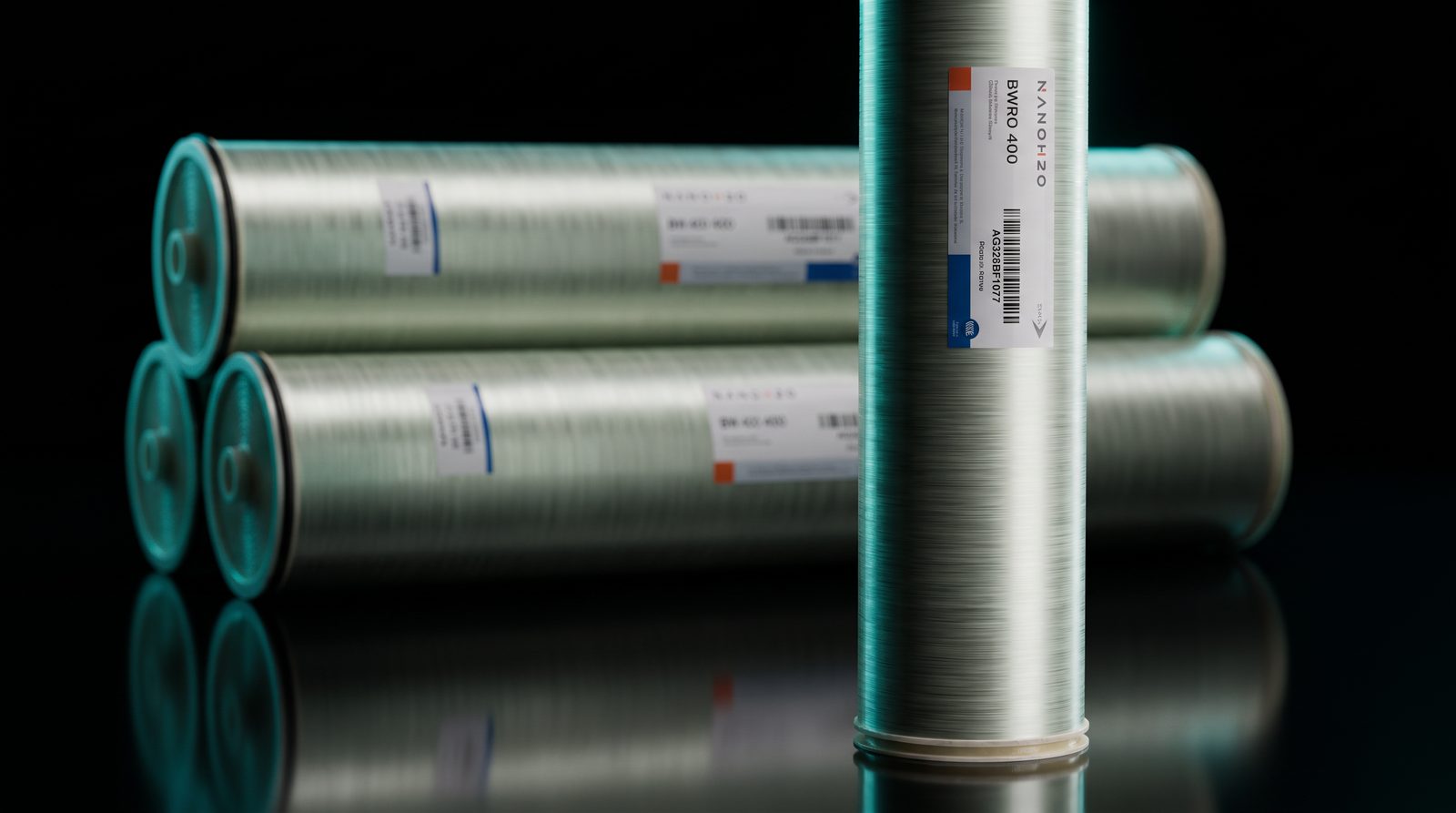
A common call: somebody asks what a replacement membrane costs. It sounds like one question but it's two. If they mean the element, that's a catalog lookup: an 8-inch brackish element ran $603 to $916 in the July 2026 listings below, depending on whose name is on the fiberglass. If they mean the changeout, the number is bigger, and most of it never appears on a membrane quote.
Take a small three-vessel machine, six elements per vessel. Eighteen elements at the table's $603 to $916 is $10,854 to $16,488 before anyone touches a wrench. Add a crew for a day, a day of lost production, new brine seals, and the flush, and the changeout costs more than the elements. And if the thing that killed the old membranes is still in the system, you get to spend it again.
So the useful version of the question has three parts: what the elements cost brand by brand, what the rest of the invoice looks like, and when replacement actually beats another cleaning. The prices below come from distributor listings pulled the week of July 13, 2026.
What 8-inch brackish elements cost right now
All of these are 400 ft² brackish elements that fit the same 8040 vessel. Nominal performance comes from each manufacturer's current data sheet; prices are single-element street prices from US distributors.
| Element | Nominal flow / stabilized rejection | Street price (July 2026) |
|---|---|---|
| NanoH2O BW 400 R G2 | 11,500 gpd / 99.8% | Our price: $603 |
| DuPont FilmTec BW30 PRO-400 | 11,000 gpd / 99.6% | $723 to $866 |
| DuPont FilmTec BW30-400 (legacy) | 10,500 gpd / 99.5% | $766 to $916 |
| Hydranautics ESPA2-LD | 10,000 gpd / 99.6%* | $699 to $859 |
| Toray TM720-400 | No | Quote-based through distribution |
*The ESPA2-LD is a low-energy element tested at 150 psi and 1,500 ppm NaCl, so its flow number isn't directly comparable to the others, which are rated at 225 psi and 2,000 ppm. We couldn't find a published US street price for the Toray element to print. One more name note: NanoH2O is the former LG Chem membrane business: same elements, same model numbers; the LG prefix was dropped when the company became NanoH2O Co., Ltd. in December 2025.
Two things jump out of that table. First, the legacy BW30-400 costs more than the PRO-400 that superseded it. If your plant is still spec'd to the old part number, check the PRO-400 price before you reorder. Second, the spread between the cheapest and the most expensive element is over $300 for hardware that drops into the same vessel and makes the same water.
On the 4-inch side, for commercial kitchens and smaller industrial skids, a FilmTec BW30 PRO-4040 lists between $347 and $465 depending on the distributor. Same brand logic, smaller numbers.
One more pricing input people forget: when you need the elements matters almost as much as which ones you buy. Spot purchases against a dead train pay freight expediting and whatever the distributor has on the shelf. We wrote up why 8-inch elements can take weeks to arrive and how to buy ahead of the failure instead of behind it.
The rest of the invoice
The element bill is the visible half. The other half shows up as labor, parts, and a production gap.
Labor first. Sliding an element out of a vessel is quick. The day goes to everything around it: lockout, draining the train, pulling end caps, chasing the one interconnector that always leaks on restart, torquing the caps back, a slow repressurization, and a performance test before anyone leaves. Ask your contractor how many techs and hours they book for your machine. Multi-train plants stagger the work so one train carries the load, which stretches the calendar but protects production.
Hard parts are cheap until they're missing. Brine seals, interconnector o-rings, and end-cap seals should be replaced with the elements, and they cost almost nothing against the element bill. But if they're not on the truck when an old seal tears on reassembly, the machine sits while a part that costs next to nothing ships. Order a seal kit with every changeout.
Downtime is the line item that varies most. A redundant plant barely notices a changeout day. A single-train operation making process water eats the full cost of not running. What does a day without that train cost you? We break that down in the hidden cost of unplanned RO downtime.
Disposal is minor but real. Spent elements are bulky solid waste, generally non-hazardous unless your process contaminated them with something that is. Eighteen elements is a truck bed. A hundred is a roll-off conversation.
Clean first, but do the arithmetic
Against a five-figure element bill, cleaning is obviously worth trying first. The chemistry is cheap relative to hardware: price your cleaner per element per cleaning, multiply by the elements in the train, then add labor and a down day. A high-pH pass for organics and a low-pH pass for scale, done properly and early, is your best chance of pulling a fouled train back to baseline. The full procedure is in how to clean a commercial RO membrane.
The math flips when cleanings stop holding. The standard trigger for a CIP is a 10 to 15 percent drop in normalized permeate flow. When a proper two-stage cleaning no longer brings normalized flow back near baseline, or the interval between cleanings keeps shrinking, every additional CIP is money spent renting time on membranes that are already gone. Track it in dollars: add up a year of cleanings in chemicals, labor, and down days, applied to elements that are old and fading. At that point replacement isn't the expensive option anymore.
How long a set lasts depends mostly on what reaches it, and what cuts it short is the subject of the next section.
New elements, same autopsy
The expensive mistake in membrane replacement isn't overpaying for elements. It's replacing membranes without finding out what killed them.
Polyamide membranes tolerate less than 0.1 ppm of free chlorine. If the old set died because the carbon bed upstream broke through and nobody caught it, the new set starts dying the day it's loaded. Chlorine attack shows up as rejection sliding down while flow creeps up, and by the time it's obvious, the damage is permanent. A five-figure element order does not fix a carbon problem, it just resets the clock on the same failure.
Scale does the same thing on a slower clock. An antiscalant pump that lost prime, or a dose that was never rechecked after the well chemistry shifted, will take out a new membrane set on the same schedule it took out the old one. We covered how antiscalant programs fail in detail, and the short version is that the failure is usually in the dosing, not the chemical.
Before the purchase order goes out, pull the worst element and look at it. Weigh it if you can; a fouled 8040 is noticeably heavier than a new one. Cut one open if the system's history is murky. Ten minutes of autopsy tells you whether you're buying membranes or buying pretreatment, and buying the wrong one means paying for both.
Practical Bottom Line
The current spec sheets make the brand comparison short. The NanoH2O BW 400 R G2 rates 11,500 gpd at 99.8 percent stabilized rejection with a 34-mil feed spacer, at $603. The FilmTec BW30 PRO-400 rates 11,000 gpd at 99.6 percent with a 28-mil spacer, from $723. That's more flow, higher rejection, and $120 to $263 less than the BW30 PRO-400 listings we found in July 2026. Spec the changeout on the data sheet and the price, and the changeout specs itself. The side-by-side is in our BW 400 R G2 vs BW30 PRO-400 comparison.
Enviro Membranes stocks genuine NanoH2O (formerly LG) RO elements in McAllen, Texas. See current models and prices at enviromembranes.com/shop. If you're pricing a changeout, send us your water analysis and we'll tell you which membrane fits.
Sources
- NanoH2O BW 400 R G2 Product Data Sheet: NanoH2O (formerly LG Water Solutions)
- FilmTec BW30 PRO-400 Product Data Sheet: DuPont Water Solutions
- ESPA2-LD Element Specification Sheet: Hydranautics / Nitto
- The Real Cost of RO Membrane Cleaning: ZwitterCo
- Cost of fouling in full-scale reverse osmosis and nanofiltration installations: Desalination (ScienceDirect)
- DOW FilmTec BW30-400 Product Information: Lenntech
- Membrane CIP (Clean-in-Place): A Complete Guide: Kurita America
- Replace or Clean? A Plant Manager's Decision Checklist for RO Membranes: Enviro Membranes
- How to Read a Normalized RO System Performance Report: Enviro Membranes