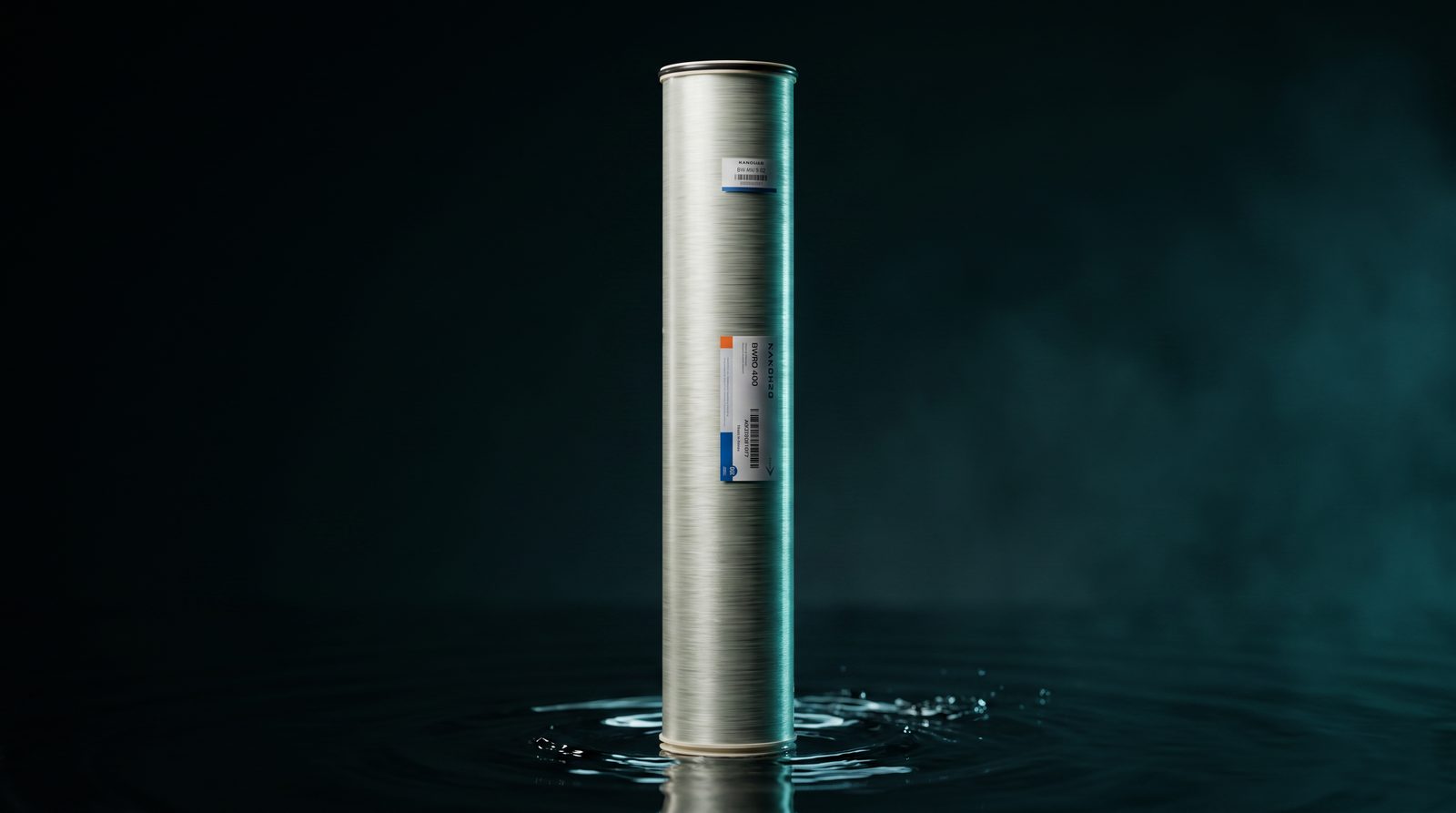
The NanoH2O BW 400 R G2 (formerly LG NanoH2O, the LG Chem water business became NanoH2O Co., Ltd. in December 2025) and the DuPont FilmTec BW30 PRO-400 compete for exactly the same installation: large industrial and commercial brackish water RO systems running 8-inch elements. Same physical format, nearly the same test conditions. The spec sheet shows LG at 99.8% stabilized salt rejection against FilmTec's 99.6%, a clear lead on paper. But plenty of systems where LG would outperform end up running FilmTec instead, because the default is FilmTec and nobody stopped to check whether the application justified switching.
This breaks down where the specs actually diverge, what the rejection difference costs you in real permeate quality, and which applications make LG worth the procurement change.
What the Spec Sheets Say
Both elements are tested at 2,000 ppm NaCl, 225 psi, 25°C and 15% recovery. The one difference is test pH: 7 for NanoH2O, 8 for DuPont. That makes this one of the closest cross-brand BWRO comparisons, unlike pairs tested at different pressures, where direct number comparisons mislead. Here, the numbers are close to like for like.
| Specification | NanoH2O BW 400 R G2 | DuPont FilmTec BW30 PRO-400 |
|---|---|---|
| Nominal Flow (GPD) | 11,500 | 11,000 |
| Stabilized Salt Rejection | 99.8% | 99.6% |
| Minimum Salt Rejection | 99.65% | 99.4% |
| Test Pressure | 225 psi | 225 psi |
| Test NaCl Concentration | 2,000 ppm | 2,000 ppm |
| Test Temperature | 25°C (77°F) | 25°C (77°F) |
| Test Recovery | 15% | 15% |
| Test pH | 7 | 8 |
| Active Area | 400 ft² | 400 ft² |
| Membrane Technology | TFN (Thin-Film Nanocomposite) | TFC Polyamide |
| Feed Spacer | 34 mil (low-dP) | 28 mil |
| Max Operating Pressure | 600 psi | 600 psi |
| Max Temperature | 45°C (113°F) | 45°C (113°F) |
| Continuous pH Range | 2 to 11 | 2 to 11 |
| Chlorine Tolerance | <0.1 ppm | <0.1 ppm |
| NSF/ANSI 61 Certified | Yes | See NSF listing |
LG leads on flow (500 GPD) and rejection (0.2% stabilized, 0.25% minimum). Every operating limit is identical. The elements are physically interchangeable in any 8-inch pressure vessel.
What TFN Actually Means
The NanoH2O BW 400 R G2 uses Thin-Film Nanocomposite membrane chemistry. The FilmTec BW30 PRO-400 (and nearly every other commercial BWRO membrane) uses standard Thin-Film Composite (TFC) polyamide. The difference is in the active layer: TFN embeds zeolite nanoparticles, which are molecular sieves with sub-nanometer pore channels, directly into the polyamide layer during fabrication.
Those nanoparticles do two things. First, they create preferential water transport pathways that improve permeability: that's where the 500 GPD flow advantage comes from, without a corresponding drop in rejection. Second, NanoH2O says the hydrophilic nanoparticle surface makes organic molecules and microbial cells adhere less readily than to standard TFC. NanoH2O's datasheet lists "excellent fouling resistance" but publishes no number for it, so track your own cleaning intervals.
What TFN doesn't change: chlorine is still lethal to it at the same threshold as every polyamide membrane (<0.1 ppm free chlorine). Pressure limits, temperature limits, and cleaning protocol are unchanged. The element drops into an existing 8-inch vessel without modification.
How Much the Rejection Difference Actually Matters
The 0.2% gap in stabilized rejection sounds like a rounding error. Whether it matters depends entirely on feed TDS and your permeate quality target.
| Feed TDS | NanoH2O BW 400 R G2 Permeate (99.8% rejection) | FilmTec BW30 PRO-400 Permeate (99.6% rejection) |
|---|---|---|
| 500 ppm (light municipal) | 1 ppm | 2 ppm |
| 1,000 ppm | 2 ppm | 4 ppm |
| 2,000 ppm (standard test condition) | 4 ppm | 8 ppm |
| 3,000 ppm (brackish well) | 6 ppm | 12 ppm |
For a drinking water production system at 500 ppm feed, both elements produce permeate that's well below any regulatory limit. The difference is 1 ppm. It doesn't matter.
For a boiler makeup or high-purity process system targeting <10 ppm permeate from 2,000 ppm feed, LG gives you 6 ppm of headroom before the permeate spec gets tight. FilmTec gives you 2 ppm. As elements age and rejection drifts down from the initial value (which it does, consistently, over time) that headroom becomes real operating margin. Designing a system against FilmTec's minimum rejection floor (99.4%) at 2,000 ppm feed means tolerating 12 ppm permeate on a low-performing element in the lot. That may push you toward a polishing stage that wouldn't have been necessary with LG's tighter 99.65% minimum.
Design to the minimum rejection figure, not the stabilized one. Stabilized is the typical value for the lot. Minimum is the lowest value the manufacturer publishes for any element in the lot. And that's the number your system has to survive on a bad day.
Why FilmTec Wins Most Procurement Decisions Anyway
If LG publishes more flow and better rejection at identical operating limits, why is FilmTec the default in so many commercial system designs?
Installed-base inertia is most of the answer. DuPont itself calls the BW30 an industry standard with decades of proven performance, and many system engineers learned to design around it. When elements are due for replacement, the default path is ordering what came out. Switching to LG means re-establishing a supplier relationship, validating the element in the specific application, and taking on the risk, however small, that behavior differs from what the design assumed. For most procurement decisions, that friction isn't worth 500 GPD and 0.2% rejection.
DuPont's technical support infrastructure is also meaningfully deeper in the US market. For large industrial installations where a startup problem at 2 AM costs serious money, the factory engineer network, regional distributor depth, and established troubleshooting playbooks behind FilmTec are a real risk-mitigation asset.
And for many applications, 99.6% rejection is simply good enough. If the system produces drinking water or general process water from 500 to 1,200 ppm municipal feed, specifying LG to gain 0.2% rejection is optimizing past the point of relevance. The prudent procurement call is the one that meets the spec with the lowest sourcing risk.
When LG Is the Better Specification
Two specific scenarios make LG worth the switch:
Tight permeate quality targets with high-TDS feed. If the system needs to deliver consistently below 10 ppm permeate from a 1,500 to 3,000 ppm feed, LG's rejection advantage and tighter minimum floor give you operating margin that FilmTec doesn't. This is most relevant in second-pass RO upstream of boilers, pharmaceutical water systems, or any application where the product water spec has little tolerance for variance. LG's 99.65% minimum means the worst element in the lot still delivers 5 ppm permeate at 1,500 ppm feed. FilmTec's 99.4% minimum means potentially 9 ppm. That gap affects whether you can stay in spec through a full element lifecycle without a mid-cycle replacement.
Feed water with significant organic or biological loading. NanoH2O says its TFN surface resists organic fouling but publishes no number for it, so your own CIP log decides. If your CIP log shows cleaning cycles tightening (from every six months to every three months, for example) and your feed has elevated TOC, humic acids, or seasonal biological loading, running LG elements for two full operating cycles and tracking CIP intervals is a legitimate ROI calculation. Fewer cleanings means less membrane stress, less downtime, and lower chemical costs. If the intervals extend, the switch paid for itself. If they don't, you still have the G2's higher published flow and rejection.
Bottom Line
On the published datasheets the NanoH2O BW 400 R G2 shows higher flow, higher rejection and a tighter minimum floor than the FilmTec BW30 PRO-400, at the same operating limits and in the same physical format.
For new system designs: the NanoH2O BW 400 R G2 should be your design basis. The 500 GPD per element advantage and 0.2% better rejection compound at scale: across a 6-vessel, 6-element system that's 18,000 GPD additional permeate capacity and a consistently cleaner product water stream from the same footprint.
For existing systems running FilmTec elements: when replacement time comes, switching to LG is physically seamless (the elements are interchangeable) and the datasheets put the G2 ahead on flow and rejection. The support concern is real, so get NanoH2O's technical manual and bulletins before the changeout.
Pull the actual manufacturer data sheet, confirm test conditions match your application, and size against the minimum rejection figure. That number (99.65% for LG, 99.4% for FilmTec) is what your system has to live with on its worst day.
Enviro Membranes stocks genuine NanoH2O (formerly LG) RO elements in McAllen, Texas, with same-day shipping. See current models and prices at enviromembranes.com/shop.
Comparing replacement options? Send us your water analysis and permeate target at enviromembranes.com, and we'll tell you which membrane fits.
Sources
- NanoH2O BW 400 R G2 Product Page, NanoH2O (formerly LG Water Solutions)
- DuPont FilmTec BW30 PRO-400 Product Data Sheet, Rev. 4 (Nov 2024), DuPont Water Solutions
- FilmTec vs. Hydranautics vs. Toray: How to Compare RO Membranes, Enviro Membranes
- How to Extend RO Membrane Life, Enviro Membranes
- When to Replace RO Membranes, Enviro Membranes