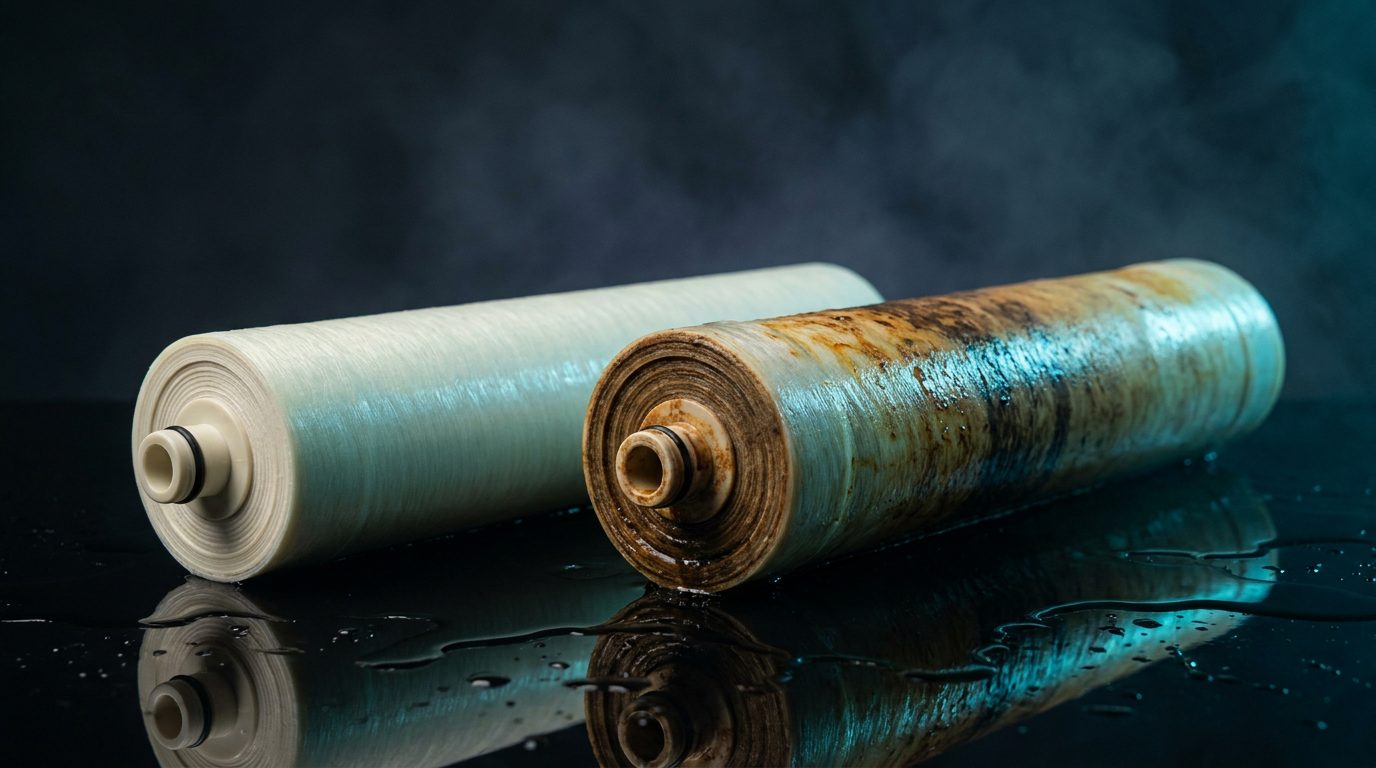
How to read your system's performance data, make the call with confidence, and avoid the most expensive mistake in RO membrane management
The question comes up every time RO system performance starts slipping: do you run a clean-in-place cycle, or pull the elements and replace them? Get it wrong in one direction and you pay for a CIP that doesn't recover performance. Get it wrong in the other direction and you replace a membrane set that still had life in it.
The decision doesn't have to be a guess. There are three measurable performance indicators that tell you which way to go, and a straightforward sequence for using them before you call the service crew or place a parts order.
The Three Numbers That Make the Decision
DuPont FilmTec's cleaning procedures manual specifies the performance thresholds that trigger a CIP. These are manufacturer-published criteria, not rules of thumb. Combined with post-CIP test results and the pattern of how values are changing, they drive the replace-or-clean call.
The three indicators are normalized permeate flow, normalized salt passage, and differential pressure across the system. "Normalized" means adjusted for current feed water temperature and pressure so you're comparing apples to apples against your commissioning baseline.
1. Normalized Permeate Flow (NPF)
This is your primary indicator. It measures how much treated water the system is producing relative to what it produced on day one, after adjusting for temperature and feed pressure.
10% decline from baseline → Run a CIP cycle (DuPont published threshold)
20 to 30% decline → CIP, but recovery may be incomplete
30 to 50% decline → Elements likely need replacement; CIP first to confirm
A 10% NPF drop is the clean-now signal. It means fouling is present but hasn't compounded: a proper CIP cycle should recover close to full performance. A 30% drop means fouling is advanced. CIP may partially recover performance, but if it doesn't get you back near baseline, you're replacing elements.
2. Normalized Salt Passage (NSP)
Salt passage measures how much dissolved salt is crossing the membrane into the permeate stream. A rising salt passage value means the membrane's rejection capability is degrading.
5 to 10% increase from baseline → Run a CIP (DuPont published threshold); investigate for early biofouling or scaling
Sudden jump (overnight or over a few days) → Likely O-ring failure or physical membrane damage, not a fouling issue
Gradual rise over months with stable NPF → Membrane aging; plan replacement
The pattern matters as much as the number. A slow, gradual rise in salt passage over many months, with permeate flow holding relatively steady, usually means the membrane is aging normally toward end-of-life. A sudden, sharp jump is almost never fouling: it's a mechanical failure (O-ring blow-out, physical puncture, or oxidation damage from chlorine exposure) and CIP won't fix it.
3. System Differential Pressure (ΔP)
Differential pressure measures the pressure drop from feed inlet to concentrate outlet across your membrane array. Rising ΔP means something is blocking the feed water flow path: typically particulate fouling in the feed spacers or biological growth.
15% increase from baseline → Run a CIP cycle (DuPont published threshold); prioritize acid wash for scale, alkaline wash for biological fouling
Rapid ΔP rise (days, not months) → Check pretreatment: cartridge filter may have failed
Note: DuPont also specifies a maximum absolute pressure drop of 15 psi per element or 50 psi per multi-element vessel, exceeding these risks permanent membrane damage regardless of the percentage change from baseline
The Decision Checklist
Run through this when performance starts declining. You need your current normalized values and your commissioning baseline. If you don't have a commissioning baseline, record today's values; that becomes your new reference point.
| Performance Signal | → Run a CIP | → Replace Elements |
|---|---|---|
| NPF dropped 10 to 20% from baseline | ✓ CIP recommended | |
| NPF dropped more than 30% from baseline | ✓ CIP first, test after | ✓ If CIP does not recover performance |
| Salt passage up 5 to 10%, gradual over months | ✓ Monitor closely | ✓ If trend continues rising |
| Salt passage jumped sharply (days) | ✓ O-ring/damage, CIP won't help | |
| ΔP up 15% from baseline | ✓ CIP recommended | |
| ΔP approaching 15 psi/element absolute | ✓ Urgent CIP | |
| Post-CIP: performance recovers near baseline | ✓ Continue operating | |
| Post-CIP: performance does not recover | ✓ Elements at end of life | |
| Elements have run 3 to 5+ years in normal conditions | ✓ CIP as maintenance | ✓ If approaching or past 5 years |
| Chlorine confirmed in feed water (polyamide membranes) | ✓ Damage is irreversible |
The rule of thumb embedded in this checklist: clean when the data tells you to, and let the post-CIP performance test tell you whether you're cleaning or replacing. Deciding to replace before running a CIP is almost always premature. Running a second or third CIP when post-clean performance tests show the elements can't recover is almost always throwing money away.
What It Actually Costs
Part of the reason this decision gets deferred, or made wrong, is that the cost comparison isn't laid out clearly. Here it is:
| Action | What You Pay | When It Works |
|---|---|---|
| CIP cleaning (acid + alkaline wash) | Chemicals, labor and a down day | Fouling caught at 10 to 20% decline, performance recovers fully |
| CIP cleaning (late-stage, 30 to 50% decline) | Chemicals and labor, plus a longer outage | May partially recover; often only buys a short reprieve before replacement is needed anyway |
| Element replacement (8040) | Several hundred dollars per element, times every element in the array | Irreversible fouling; damage confirmed by post-CIP test |
| Emergency sourcing + express freight | Expedited freight on top of list price | Unplanned failure with no spare inventory; the most expensive scenario |
Actual costs vary by system size, element specification, and location. The relevant comparison is between the cost of a timely CIP (caught at 10%) versus the cost of a delayed CIP that doesn't recover performance (caught at 40 to 50%), which means you've paid for both the CIP and an immediate replacement. That combination is the most expensive outcome, and it's the one that results from not monitoring.
One Failure Mode That Looks Like Fouling But Isn't
Chlorine oxidation of polyamide membranes is the failure mode most often misdiagnosed as fouling. When a membrane is exposed to free chlorine in the feed water, the polyamide thin-film layer degrades, slowly at first, then accelerating. The result is rising salt passage, sometimes accompanied by a permeate flow increase (the damaged membrane becomes more permeable as it degrades).
The key difference: fouling causes permeate flow to drop. Chlorine damage often causes permeate flow to hold steady or even increase while salt rejection falls. If your normalized salt passage is rising but permeate flow is stable or going up, check whether free chlorine is getting through to the membranes before you schedule a CIP.
Chlorine damage to polyamide membranes is irreversible.
No CIP chemistry will recover a membrane that has been oxidized. If chlorine exposure is confirmed, the elements need replacement and the pretreatment (typically activated carbon or sodium metabisulfite dosing) needs to be fixed before the new set goes in.
What the Data Tells You
The clean-versus-replace decision is straightforward when you have normalized performance data to work from. Without baseline data, you're guessing, and guessing wrong in either direction costs money. If your facility doesn't have a monthly data logging protocol, starting one today is the highest-return maintenance improvement you can make to your RO program.
The sequence: log monthly, clean at the published normalized flow and pressure thresholds, test performance after cleaning, replace only when post-CIP performance confirms the elements can't recover. That order of operations consistently produces lower maintenance costs than any calendar-based approach.
Enviro Membranes stocks genuine NanoH2O (formerly LG) RO elements in McAllen, Texas, with same-day shipping. See current models and prices at enviromembranes.com/shop.
If you've run a post-CIP performance test and need replacement elements, or if you're not sure which element fits your system, reach us at enviromembranes.com or call our McAllen office.