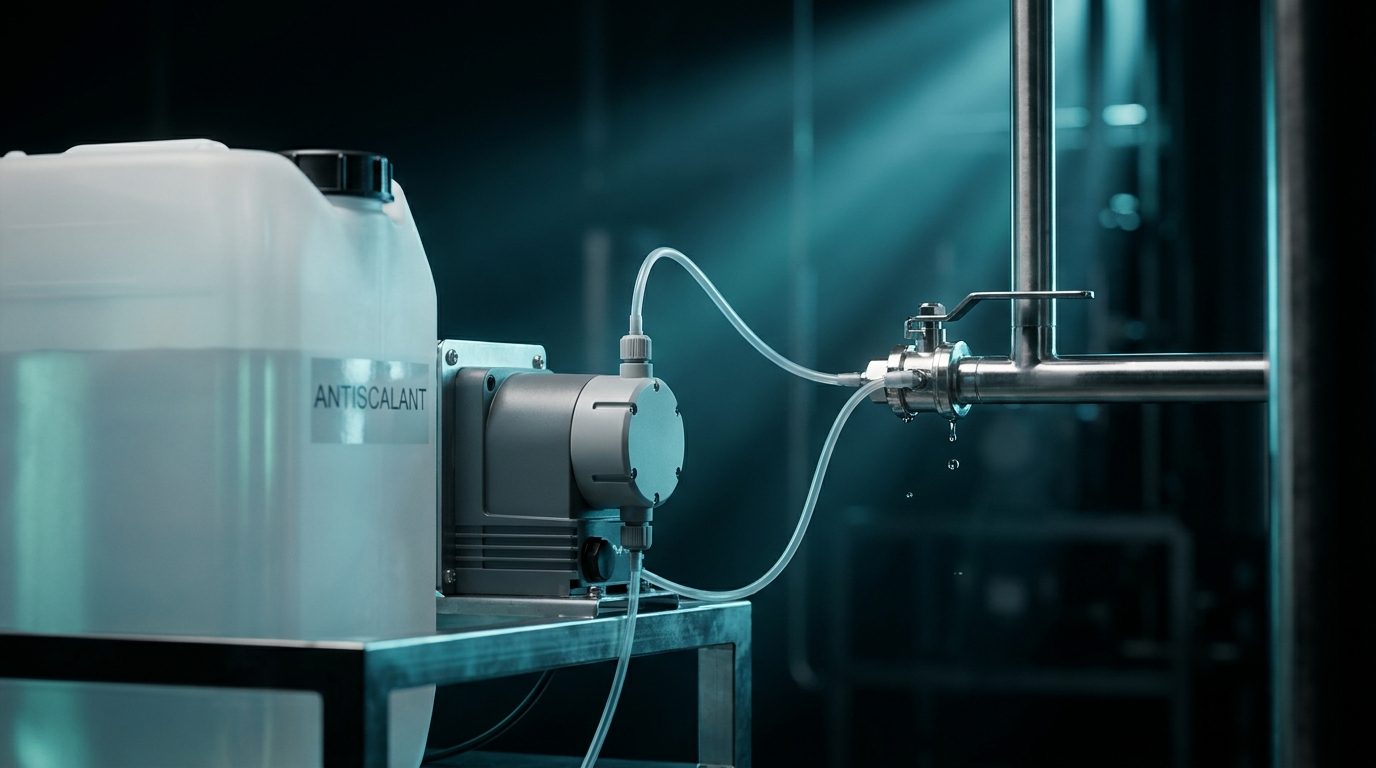
A food plant outside Harlingen runs a two-stage brackish RO at 75% recovery. The antiscalant pump got set at commissioning, 3 mg/L against the well analysis the installer had in hand, and it stayed there for six years. In year four the plant brought a second well online and started blending. Nobody re-ran the scaling projection, because nothing obvious changed. The permeate stayed clean and the array kept making water.
By the time the second-stage pressure drop got anyone's attention, the tail elements were down to a third of their original flow, and the autopsy lab scraped calcium carbonate off the membrane surface in flakes. The dose wasn't wrong. It was right for water that stopped existing two years earlier.
Scale Shows Up Where the Water Leaves
Everything about antiscalant dosing follows from one number: the concentration factor. At 75% recovery, every dissolved ion in your feed is four times more concentrated in the concentrate stream. Push recovery to 80% and it's five times. Your feed can sit comfortably below saturation for calcium carbonate all day while the water flowing across the last element in the array is supersaturated and looking for somewhere to crystallize. That's why scale almost always starts in the tail elements and works backward, and why a feed analysis alone tells you very little about scaling risk. It's the same arithmetic that sets your recovery limit in brackish service.
The chemical's job is stranger than most operators assume. An antiscalant doesn't dissolve scale, and it doesn't bind calcium the way a softener does. At 2 to 5 mg/L there isn't remotely enough of it for that; the hardness it holds off can run to hundreds of mg/L. What it does is adsorb onto the surfaces of microcrystals as they start to form and stall their growth. Chemists call it threshold inhibition. The crystals never get big enough to matter during the few minutes the water spends in your pressure vessels, and then they leave with the concentrate. The antiscalant doesn't win the fight. It delays the loss until the water is out of the building.
The Limits That Set Your Dose
Membrane manufacturers publish hard numbers for how much supersaturation their elements tolerate, and the dose comes out of running your feed analysis and recovery against those limits. DuPont's FilmTec technical manual is the reference most of the industry designs against, and its calcium carbonate limits are specific. With acid dosing alone and no antiscalant, the Langelier Saturation Index in the concentrate has to stay negative. Dose sodium hexametaphosphate to 20 mg/L in the concentrate and you can run concentrate LSI up to 1.0. A good modern polymeric antiscalant moves that to 1.5, and many products are certified by their suppliers to a concentrate LSI of 1.8.
Sulfate scales get the same treatment. FilmTec allows calcium sulfate up to twice its saturation limit with an approved inhibitor dosed per the supplier's instructions, and barium and strontium sulfate up to 50 times saturation. That 50x sounds generous until you remember barium sulfate is close to impossible to clean off a membrane once it forms; the margin exists because barium is usually present in trace amounts and precipitates slowly. Silica doesn't get a single number at all. The manual has you calculate corrected silica solubility for your pH and temperature and hold concentrate silica below it, or below whatever higher figure your inhibitor supplier will stand behind.
In practice nobody does this math by hand. Avista's Advisor software, or the projection tool from whoever supplies your chemical, takes the water analysis and recovery and returns a product and a dose, and typical answers land between 2 and 5 mg/L in the feed. The reason to understand the limits underneath is knowing when the answer has expired. Any change to feed source, recovery, or operating temperature is a new projection, not a note in the logbook.
Match the Chemistry to the Salt That Limits You
Carbonate scale is the easy case. Nearly every commercial antiscalant handles CaCO3, so if your projection says carbonate is the only risk, dose economics can drive the pick. The field narrows fast when something else is limiting.
Silica needs a formulation built for it. Avista's Vitec 4000 is a silica-specific inhibitor rated to hold silica at up to 2.8 times saturation without acid dosing, and it keeps performing with up to 4 mg/L of ferrous iron in the concentrate. That iron tolerance matters because iron and silica travel together in a lot of Texas well water, and iron catalyzes silica polymerization and degrades some silica chemistries. Vitec 5100 covers the broad case (calcium carbonate, calcium sulfate, barium sulfate, silica) and is aimed at high-iron, high-organic feeds. Veolia's Hypersperse line and Nalco's PermaTreat line carve up the same territory their own way. The brand matters less than the match. Dose a general-purpose carbonate product into a high-silica feed and your projection was fiction.
Sodium hexametaphosphate deserves a mention because older systems still run it. SHMP is cheap and it works, but it hydrolyzes in the day tank, and hydrolyzed SHMP is worse than nothing: the breakdown products precipitate with calcium and create a calcium phosphate scaling risk on top of the carbonate problem you started with. FilmTec's guidance dates from when SHMP was the standard and reads like a warning label. Keep it fresh, and dose it to hit 20 mg/L in the concentrate, which works out to 5 mg/L in the feed at 75% recovery. Polymeric antiscalants took over because they hold more supersaturation at a lower dose and don't rot in the tank.
The Dosing Skid Is Half the Program
Where the chemical enters the system matters. The standard arrangement injects downstream of the media filters and upstream of the cartridge filters. That gives the chemical mixing length before it reaches the membranes and lets the cartridges catch anything undissolved. Injecting after the cartridges skips that insurance.
Dilution water is the mistake I see most on small skids. If you dilute the neat product, use RO permeate or DI water, and don't take the solution below about 10% strength. Below that the formulation loses its biological stability and the day tank starts growing things, and a slimy day tank feeds slime directly to your cartridge filters and membranes. Raw feed water is worse still, since it carries the hardness the chemical is supposed to be fighting into the one place it's most concentrated.
Two habits from the Hydranautics pretreatment bulletin that most small systems skip: stop the antiscalant injection during low-pressure flushes when feed water is the flush source, and flush the chemical out of the elements at shutdown. Antiscalant only works in moving water. Left sitting in a stalled vessel, it settles onto the membrane and becomes a foulant on its own schedule.
And calibrate the pump against a drawdown cylinder on a schedule, not when something looks off. A diaphragm pump that's lost prime, a weeping check valve, a cracked suction fitting: all of them read as "pump running" from across the room while your effective dose sits near zero. At 3 mg/L there's no visible difference between dosing and not dosing. The membranes find out first.
When the Antiscalant Becomes the Foulant
The failure everyone designs against is underdosing. The one that gets misdiagnosed is the opposite. When a system starts scaling, the reflex is to turn the pump up, and there's a persistent instinct that extra chemical is cheap insurance. It isn't. Antiscalants are anionic polymers, and overdosed polymer deposits on the membrane as an organic film. The symptom is falling permeate flow with normal salt passage, which looks nothing like scale and a lot like organic fouling, because that's what it is. I've seen systems where the fix for a scaling event was doubling the dose, and six months later the membranes came out coated in the cure.
The uglier version involves coagulant. Plants with turbidity problems often dose a cationic polymer ahead of the media filters. If that carries over into the RO feed, it meets your anionic antiscalant and reacts on contact. FilmTec's manual describes the result as gum-like products that are very difficult to remove from the elements, and that's the polite version. In the field it means lead elements that gain differential pressure fast and don't respond to either the high-pH or low-pH cleaning you'd normally throw at fouling. If you run any cationic chemistry upstream of an RO, jar-test it against your antiscalant and make sure filtration is sized so carryover can't happen.
Both failures share a tell: the dosing program looked fine on paper the whole time. The pump ran, the tank drained on schedule, the log got initialed. A chemical program never self-reports. The numbers that tell you whether it's working are normalized permeate flow and differential pressure by stage, trended over weeks. If you're not normalizing your performance data, scale gets months of free run time before the raw numbers show it.
Practical Bottom Line
Set the dose from a current water analysis run through a projection, and re-run the projection every time the feed, the recovery, or the season changes. Match the chemistry to the salt that limits your system, not to whatever your supplier had on the truck. Then trust the trend data over the pump hum. Scale doesn't care whose membrane is in the vessel, but the membrane still matters when you're specifying the rest of the system: for 8040 brackish work we spec NanoH2O's BW 400 R G2 (formerly LG), because its higher rejection and flow give you operating margin the chemical program doesn't have to supply. Good chemistry protects a membrane. It doesn't upgrade one.
Enviro Membranes stocks NanoH2O (formerly LG) 8040 elements (BW 400 R G2, BW 440 R G2, SW 400 R) in McAllen, Texas, ready to ship across the Rio Grande Valley and beyond. If your system is scaling faster than it should, send us your latest water analysis and normalized data and we'll take a look, no charge. Reach us through enviromembranes.com.
Sources
- Chemical Pretreatment for RO and NF, Technical Application Bulletin TAB111, Hydranautics (Nitto)
- FilmTec™ Calcium Carbonate Scale Prevention, Technical Manual Excerpt (Form 45-D01552-en), DuPont Water Solutions
- Vitec™ 4000 Antiscalant Product Page, Avista Membrane Treatment Solutions (Kurita)
- Vitec™ 4000 Antiscalant Product Data Sheet, Avista Technologies
- Vitec™ 5100 Antiscalant Product Page, Avista Membrane Treatment Solutions (Kurita)
- Brackish Water Reverse Osmosis: Why Feed Chemistry Sets Your Recovery Limit, Enviro Membranes
- How to Clean a Commercial RO Membrane (So the Cleaning Actually Holds), Enviro Membranes
- How to Read a Normalized RO System Performance Report, Enviro Membranes