Why you can't just compare the numbers on the spec sheet, and how to make a real apples-to-apples evaluation between the three most common commercial RO membrane brands
When engineers and procurement managers compare RO membrane brands, they usually pull the spec sheets, line up the flow rates and rejection percentages, and pick the winner. The problem: those numbers aren't tested under the same conditions. FilmTec, Hydranautics, and Toray each use different standard test pressures and feed water concentrations, which means a direct numeric comparison across brands is misleading without understanding what the numbers are actually measuring.
This article breaks down the three brands across the specs that matter, explains where the test condition differences are, and maps out which product is the right choice for which application.
Why You Can't Compare the Numbers Directly
Standard membrane test conditions in the industry use 225 psi feed pressure, 2,000 ppm NaCl feed water, 77°F (25°C), and 15% recovery. FilmTec's BW30 PRO series uses exactly these conditions. Hydranautics uses 225 psi for its CPA (Composite Polyamide) line but drops to 150 psi and 1,500 ppm NaCl for the ESPA (Energy Saving Poly Amide) line. Toray's TMH series tests at 100 psi and 500 ppm NaCl, dramatically easier conditions than the standard.
The practical consequence: Toray's TMH10A-4040 shows 2,400 GPD on its spec sheet. That looks competitive with FilmTec's BW30 PRO-4040 at 2,600 GPD. But the Toray number was generated at less than half the test pressure against feed water four times less concentrated. At 225 psi with 2,000 ppm feed, the Toray element would produce more flow, but it's being pushed well above its rated maximum operating pressure of 365 psi in typical brackish water applications. The specs are not measuring the same thing.
⚠ Spec sheet flow rates are only comparable when test conditions match.
FilmTec BW30 PRO and Hydranautics CPA5-LD are tested at similar conditions (225 psi / 1,500 to 2,000 ppm) and are directly comparable. The ESPA2-LD and Toray TMH10A are tested at lower pressures and represent a different product category: high-efficiency, low-energy elements.
The Brand and Product Line Breakdown
DuPont FilmTec is the most widely specified commercial RO membrane line globally. The BW30 PRO series is the current-generation successor to the BW30 and carries higher nominal flow and rejection than its predecessor. FilmTec's key differentiator is the widest cleaning pH tolerance in the comparison (pH 1 to 13 for 30-minute cleaning cycles), which gives it the most flexibility in aggressive CIP protocols. It's the default specification in a wide range of system designs, which means OEM compatibility and replacement sourcing are straightforward.
Hydranautics (a Nitto company) runs two distinct commercial product lines. The CPA (Composite Polyamide) series is the high-rejection, full-pressure line: the CPA5-LD-4040 carries 99.7% nominal rejection tested at 225 psi and is the correct comparison point against FilmTec's BW30 PRO. The ESPA (Energy Saving Poly Amide) series is tested at lower pressure and designed for energy-efficient applications where operating at reduced feed pressure is the priority. The "-LD" suffix on both lines denotes Hydranautics' Low Differential technology, a feed spacer and surface design that reduces colloidal fouling accumulation and extends intervals between CIP cycles.
Toray's TMH series is an ultra-low-energy design tested at conditions well below the industry standard. The TMH10A-4040's nominal rejection of 99.3% (minimum 99.0%) is lower than both FilmTec and the Hydranautics CPA line, and its maximum operating pressure of 365 psi limits it compared to the 600 psi ceiling on the other elements. Where Toray competes is energy efficiency: systems designed around low-pressure operation benefit from higher active area (87 ft² vs. 85 ft² for FilmTec, 80 ft² for Hydranautics in the 4040 format) and very low minimum operating pressure.
Side-by-Side Specifications (4040 Elements)
All data from official manufacturer product data sheets, dated 2022 to 2025. ⚠ flags specifications that differ meaningfully from the FilmTec BW30 PRO baseline.
| Specification | FilmTec BW30 PRO-4040 | Hydranautics ESPA2-LD-4040 | Hydranautics CPA5-LD-4040 | Toray TMH10A-4040 |
|---|---|---|---|---|
| Active Area | 85 ft² | 80 ft² | 80 ft² | 87 ft² |
| Nominal Flow (GPD) | 2,600 | 2,000 | 2,100 | 2,400 |
| Test Pressure | 225 psi | 150 psi ⚠ | 225 psi | 100 psi ⚠ |
| Test NaCl Conc. | 2,000 ppm | 1,500 ppm | 1,500 ppm | 500 ppm ⚠ |
| Nominal Rejection | 99.7% | 99.6% | 99.7% | 99.3% ⚠ |
| Minimum Rejection | 99.5% | 99.4% | 99.5% | 99.0% ⚠ |
| Max Operating Pressure | 600 psi | 600 psi | 600 psi | 365 psi ⚠ |
| Max Temperature | 113°F (45°C) | 113°F (45°C) | 113°F (45°C) | 113°F (45°C) |
| Continuous pH | 2 to 11 | 2 to 10.6 | 2 to 11 | 2 to 11 |
| Cleaning pH (30 min) | 1 to 13 | 1 to 12 | 1 to 13 | 1 to 12 |
| Feed Spacer | 34 mil | 34 mil | 34 mil | 34 mil |
Sources: DuPont FilmTec BW30 PRO-4040 PDS Rev. 5 (Oct 2024); Hydranautics ESPA2-LD-4040 spec sheet (Aug 2022); Hydranautics CPA5-LD-4040 spec sheet (Feb 2018); Toray TMHA Series datasheet 01-MB1-03-230113.
Cleaning pH Range
The cleaning pH range determines which CIP chemistry you can use without damaging the membrane. Most fouling falls into two categories: scale and biological/organic. Acid washes (low pH) remove scale. Alkaline washes (high pH) break down biofilm and organic fouling. The wider the pH tolerance, the more aggressive chemistry you can deploy.
FilmTec BW30 PRO and Hydranautics CPA5-LD both tolerate pH 1 to 13 for cleaning. Hydranautics ESPA2-LD narrows to pH 1 to 12, and the continuous operating limit drops to pH 10.6 versus 11 for the others. Toray TMH matches ESPA2-LD at pH 1 to 12. That one-unit difference at the alkaline end means the ESPA2-LD and Toray TMH cannot use some of the more aggressive alkaline cleaning formulations that FilmTec and CPA5-LD can handle. For systems with heavy biological fouling, this constraint matters.
Choosing the Right Element for Your Application
| Application / Need | FilmTec BW30 PRO | Hydranautics ESPA2-LD | Hydranautics CPA5-LD | Toray TMH10A |
|---|---|---|---|---|
| High-TDS feed water (>1,000 ppm) | ✓ | No | ✓ | No |
| Energy-efficient / low-pressure operation | No | ✓ | No | ✓ |
| High-purity / pharmaceutical demand | ✓ | No | ✓ | No |
| Aggressive CIP chemistry (pH > 12) | ✓ | No | ✓ | No |
| Municipal / light commercial applications | ✓ | ✓ | ✓ | ✓ |
| Low-energy with adequate rejection (>99.4%) | No | ✓ | No | No |
| Max pressure up to 600 psi systems | ✓ | ✓ | ✓ | No |
| Wide global spec coverage / OEM matching | ✓ | No | No | No |
A few notes on the table above: the "high-TDS feed water" row flags the FilmTec BW30 PRO and Hydranautics CPA5-LD as the appropriate choices for feed water above 1,000 ppm because those elements are rated and tested at pressures high enough to push against concentrated feed. The Toray TMH's 365 psi max operating pressure becomes a limiting factor in high-TDS applications where you need to drive the system harder. The ESPA2-LD is best suited to feed water in the 500 to 800 ppm range where its lower test pressure reflects realistic operating conditions.
"Wide global spec coverage" refers specifically to situations where the system was originally specified by an engineer or OEM using FilmTec as the design basis, which is common. Substituting a different brand requires verifying that the replacement meets the original specification parameters, and FilmTec's prevalence as the default specification makes it the easiest element to source against an existing design document.
Cross-Reference: Equivalent Elements Across Brands
The AXEON membrane comparison chart (the most widely used cross-reference in the US distributor market, updated 2022) places elements in equivalent categories based on performance profile, not just physical dimensions. The key finding for 4040 elements:
Standard brackish water / high rejection: FilmTec BW30 PRO-4040 ↔ Hydranautics CPA5-LD-4040 (and CPA2-4040). These are the direct replacements for each other in a system requiring full-pressure BWRO performance.
Low energy / extra-low-pressure: FilmTec XLE-4040 ↔ Hydranautics ESPA2-LD-4040 ↔ Toray TMH10A-4040. The Toray and ESPA2-LD are equivalents in the low-energy category, not in the standard brackish water category. Substituting an ESPA2-LD for a BW30 PRO is a category change, not a direct replacement.
If your system was designed around FilmTec BW30 PRO-4040 elements and you're sourcing a replacement, the Hydranautics CPA5-LD-4040 is the correct cross-reference, not the ESPA2-LD.
The ESPA2-LD, while physically interchangeable, operates in a different performance category and may not meet the original system design parameters at full operating pressure.
A Note on 8040 Elements
The same brand and product line logic applies to 8040 (8" × 40") elements. FilmTec's BW30 PRO-400 (11,000 GPD / 99.6% stabilized salt rejection, 99.4% minimum), Hydranautics' ESPA2-LD 8040 (10,000 GPD at 150 psi), and Toray's TMH20A-400C (11,000 GPD at 100 psi) follow the same test-condition and performance-category distinctions as their 4040 counterparts. For large industrial systems, the CPA5-LD 8040 is the correct Hydranautics cross-reference for the BW30 PRO-400.
Making the Call
For standard 4040 BWRO applications, FilmTec BW30 PRO and Hydranautics CPA5-LD are direct equivalents: both test at full pressure with similar results, both tolerate aggressive CIP chemistry. The practical difference between them is sourcing relationship and contractor familiarity, not performance. Hydranautics ESPA2-LD and Toray TMH10A are correct for low-energy, low-pressure designs, not direct replacements for a BW30 PRO in a full-pressure system.
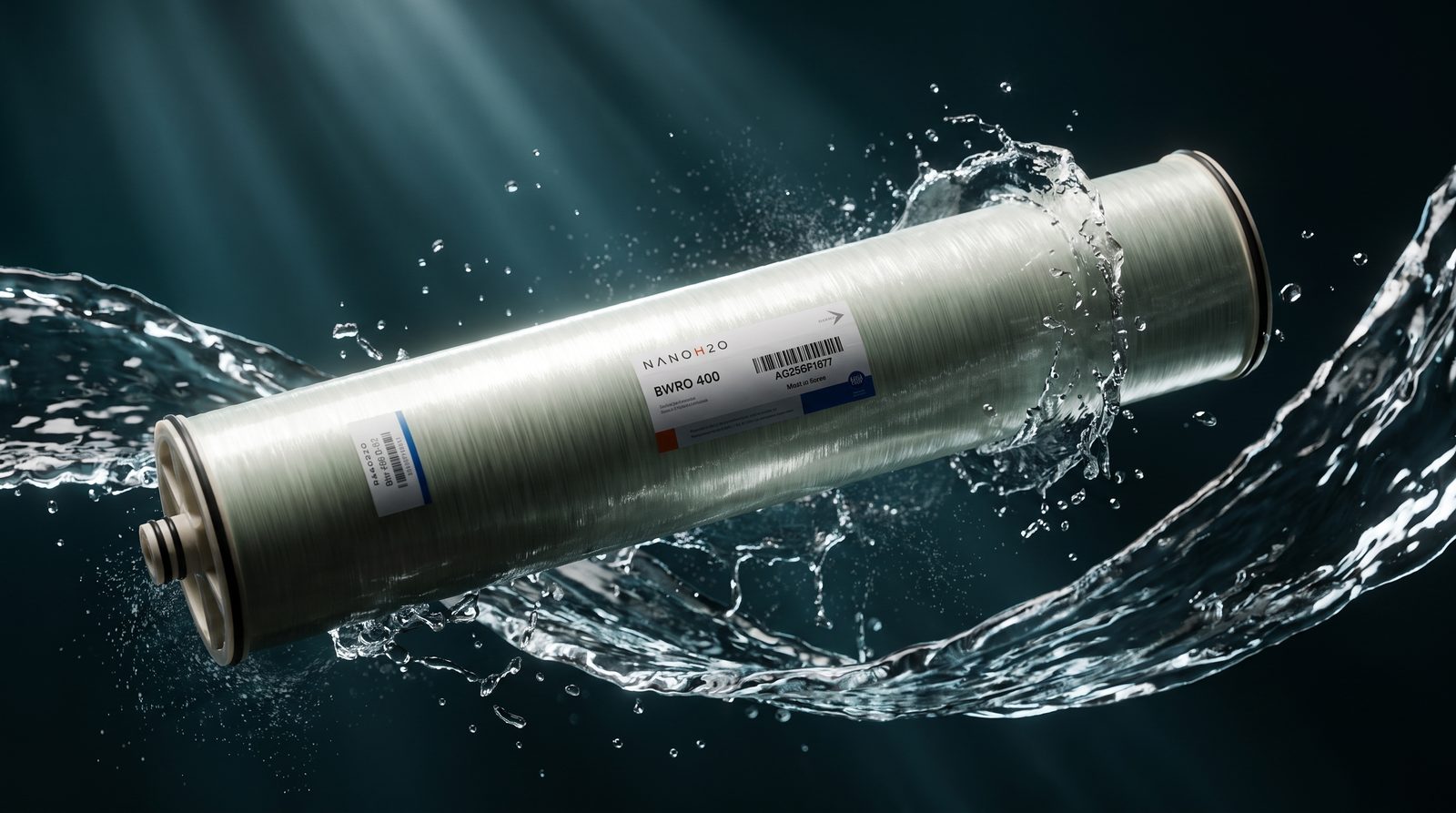
If you're specifying an 8040 system, this comparison is only part of the picture. The NanoH2O BW 400 R G2 (formerly sold as LG NanoH2O) tests at the same standard conditions as FilmTec (225 psi, 2,000 ppm NaCl) and outperforms both on flow (11,500 vs 11,000 GPD) and salt rejection (99.8% vs 99.6% stabilized). That comparison is covered separately.
For any system, the starting point is your current element model number, operating pressure, and feed TDS. The physical format (4040 or 8040) and performance category (standard vs low-energy) narrow the field. After that, it's about sourcing, lead time, and performance margin for your specific permeate target.
Enviro Membranes stocks NanoH2O BW 400 R G2 elements for 8040 industrial systems, with same-day availability in South Texas. For 4040 elements across FilmTec, Hydranautics, and Toray lines, reach us at enviromembranes.com with your element model number and we'll confirm availability.