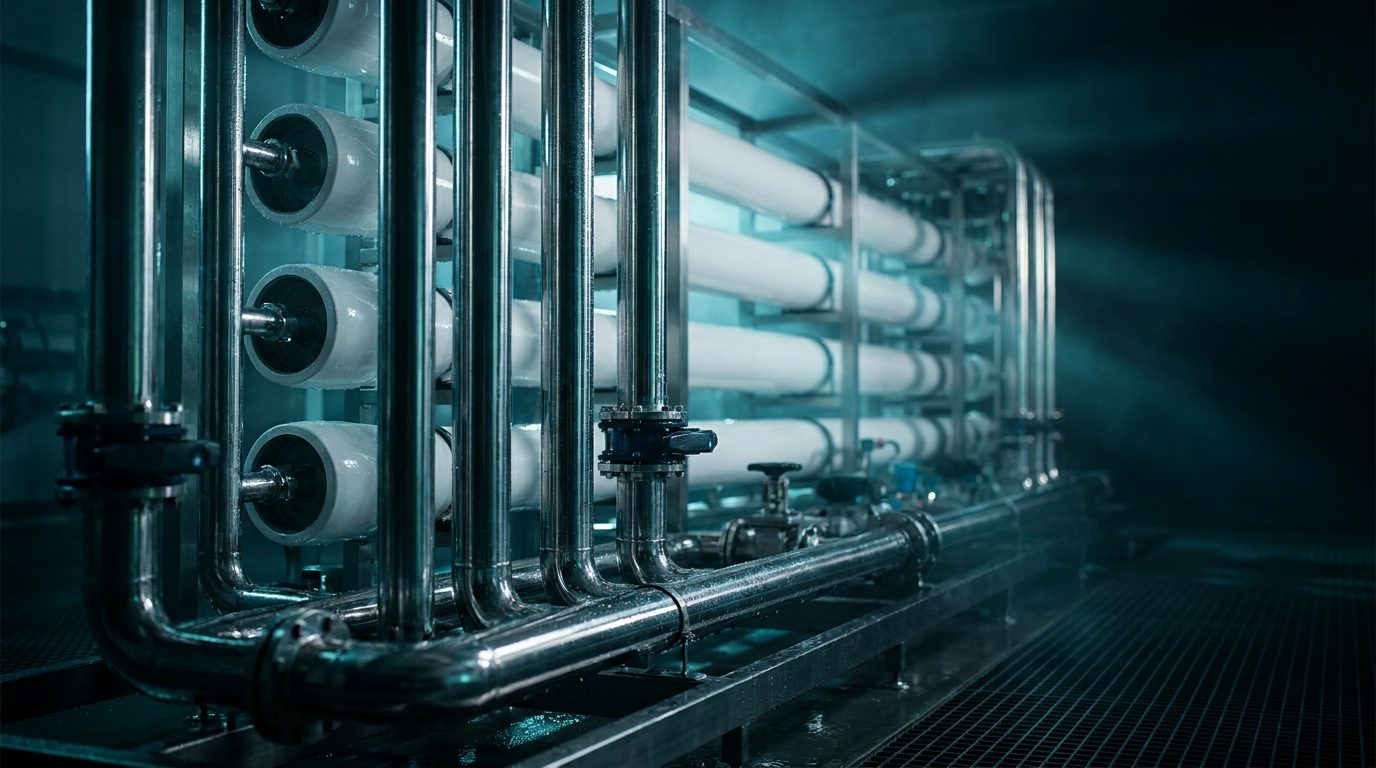
Why do RO membranes fail early? Here's what's actually shortening their life, and the operating practices that reliably extend it
How long should a commercial RO element last? It depends on the feed water and on how the system is run. Ask a plant manager whose system is running on high-TDS South Texas source water without a properly calibrated antiscalant program, and the real answer is often shorter than anyone planned.
The gap between planned life and actual life isn't bad luck. It's the result of specific, identifiable operating conditions that compound over time. Most of them are preventable.
The Four Mechanisms That Shorten Membrane Life
Scaling. When dissolved minerals (primarily calcium carbonate, calcium sulfate, barium sulfate, and silica) exceed their solubility limits in the concentrate stream, they precipitate on the membrane surface. Scale is physically difficult to remove and, if left long enough, becomes chemically bonded to the membrane material. Aggressive descaling with strong acid can remove scale but also stresses the membrane. On hard feed water like much of South Texas, scaling risk is elevated.
Biofouling. Bacteria in the feed water, even at low counts, can colonize a membrane surface and form biofilm within days under the right conditions. Biofilm is particularly resistant to cleaning. It creates a diffusion barrier that reduces flux, harbors additional fouling, and is often the cause of high differential pressure that doesn't respond well to standard CIP procedures. Municipal feed water carries some baseline microbial load regardless of disinfection, and the warm temperatures common in South Texas accelerate biofilm growth.
Oxidation. Polyamide membranes, the type used in virtually all commercial RO systems, are highly sensitive to oxidizing agents. Chlorine is the primary offender in municipal water systems. The membrane degrades on contact; the damage is cumulative and irreversible. DuPont's technical data for FilmTec elements specifies a free chlorine tolerance of less than 0.1 ppm in continuous operation. A feed stream carrying 0.5 ppm free chlorine without dechlorination accumulates 360 ppm-hours in a 30-day month, far above safe levels.
Mechanical stress. Water hammer from improper startup and shutdown sequences, over-pressurization, and frequent cycling can cause physical damage to membrane elements: telescoping, o-ring failure, and brine seal damage. These failures don't show up in performance data until they're severe, and they're not recoverable through cleaning.
How long is your current element set lasting, and how long did you plan for? Undersizing, poor pretreatment and thin monitoring all widen that gap. The difference is operating practice, not luck.
Pretreatment: The Highest-Leverage Intervention
Nothing you do at the membrane level compensates for poor pretreatment. If the water entering your RO elements isn't properly conditioned, membrane life will be short regardless of how carefully you monitor performance or how promptly you run CIP cycles.
Dechlorination. Carbon block filtration before the RO membrane is non-negotiable for municipal water supplies. Granular activated carbon (GAC) filters or sodium metabisulfite dosing are both used; carbon block is generally more consistent for smaller commercial systems. Verify dechlorination effectiveness periodically with a free chlorine test at the membrane inlet: don't assume the pre-filter is performing just because it was installed.
Antiscalant dosing. In high-hardness water like the Rio Grande Valley's, antiscalant is essential. The dosage rate and chemistry need to be matched to your actual feed water composition: hardness, alkalinity, sulfate, silica, and barium concentrations all affect which antiscalant product and what concentration applies. A generic formulation at a guessed dosage rate is not a substitute for a program built on a real water analysis. Underdosing allows scale; overdosing can foul the membrane with antiscalant itself.
SDI reduction. The Silt Density Index (SDI) measures how much particulate matter is in your feed water. Industry guidance recommends keeping SDI below 5 for standard commercial elements; below 3 is the target for best membrane life. A 5-micron cartridge filter before the membrane handles typical municipal turbidity. If your source water has high SDI (common with surface water supplies), additional pretreatment, multimedia filtration or ultrafiltration, may be needed.
Operating Parameters That Affect Longevity
How you run the system matters as much as what you put in front of it.
Recovery rate. Recovery is the percentage of feed water that becomes permeate. At 75% recovery, your concentrate stream is 4× the TDS of the feed. At 80%, it's 5×. In high-TDS water, pushing recovery too high concentrates scaling ions past their solubility limits. Running at lower recovery keeps the concentrate chemistry manageable, a tradeoff between water efficiency and membrane longevity. The right recovery rate depends on your feed water chemistry, not a rule of thumb.
Flux rate. Flux is the volume of permeate produced per unit of membrane area per unit of time, typically expressed in gallons per square foot per day (GFD). Operating at lower flux (running more membrane area at the same output) reduces fouling rate and extends element life. Systems that are undersized and running at high flux to meet demand foul faster than systems with adequate membrane area. If you're consistently replacing elements earlier than expected, check your design flux against manufacturer recommendations.
Startup and shutdown procedures. Membrane elements should be pressurized slowly on startup and depressurized gradually on shutdown. Rapid pressure changes cause water hammer that can physically damage elements. Many commercial systems include a slow-start valve or variable-speed pump drive for this reason.
| Parameter | Action Threshold | What It Signals |
|---|---|---|
| Normalized permeate flow | 10% decline from baseline | Fouling: schedule CIP |
| Normalized salt passage | 5 to 10% increase from baseline | Membrane integrity concern: investigate |
| Differential pressure | 15% increase from baseline | Particulate or bio-fouling: schedule CIP |
| Feed pressure (at same output) | Significant increase | Fouling or scale accumulation |
Clean Early, Clean Right
The single most impactful maintenance decision for membrane lifespan is when and how you clean. DuPont's published guidance sets 10% normalized permeate flow decline as the threshold for cleaning. Wait much longer and fouling may already be irreversible.
Cleaning chemistry matters too. Mineral scale requires acid cleaning (typically pH 2 to 4, using citric acid or hydrochloric acid-based cleaners). Organic fouling and biofilm require high-pH cleaning (pH 11 to 12, using sodium hydroxide or sodium dodecyl sulfate-based products). Running the wrong chemistry for the fouling type is marginally better than not cleaning at all. If you don't know what's fouling your membranes, a membrane autopsy, sending a spent element to a manufacturer's lab for analysis, will tell you exactly what's on the surface and what chemistry to use.
Temperature during CIP also matters. Most cleaning solutions are more effective at 95 to 104°F (35 to 40°C). Cold cleaning reduces chemical reactivity and may require longer soak times or repeated cycles to achieve the same result.
Proper Storage When Systems Go Offline
Membranes that go into storage dry are damaged membranes. Polyamide membrane material requires continuous hydration to maintain its structure. Let an element dry out after use and it may irreversibly lose water permeability. DuPont does publish re-wetting procedures for dried-out elements, an ethanol or propanol soak or a pressurized soak with the permeate port throttled, but those are salvage attempts that might work rather than a routine fix. Plan on keeping the element wet.
Short-term shutdown (less than 30 days): flush the system with RO permeate and keep the elements wet. Ensure no air enters the pressure vessels. Check weekly.
Long-term storage or spare element inventory: store in a 1 to 2% sodium metabisulfite (SMBS) solution in sealed, opaque bags at 40 to 95°F (4 to 35°C). Keep out of direct sunlight and away from freezing temperatures. Before returning stored elements to service, flush thoroughly with RO permeate: bisulfite residual on the membrane surface will affect early performance readings.
The Cumulative Effect
None of these practices produces a dramatic immediate result. The benefit shows up over time: in fewer CIP cycles per year, in performance baselines that hold steady longer, and in elements that stay in service longer.
The facilities that get long service from their membrane elements are not operating in easier conditions than facilities that replace early. They've just made the pretreatment, operating parameter, and monitoring decisions that accumulate into the difference.
Enviro Membranes stocks genuine NanoH2O (formerly LG) RO elements in McAllen, Texas, with same-day shipping. See current models and prices at enviromembranes.com/shop. When it's time to replace elements, send us your water analysis and we'll tell you which membrane fits.
Sources
- DuPont FilmTec Cleaning Procedures Manual, CIP thresholds and chemistry guidance
- RO Membrane Lifespan, Maintenance & Replacement Guide, AMPAC USA (storage procedures)
- Typical Lifespan of an Industrial RO Membrane, Aqualitek
- DuPont FilmTec BW30 PRO-4040 Product Data Sheet, free chlorine tolerance specification