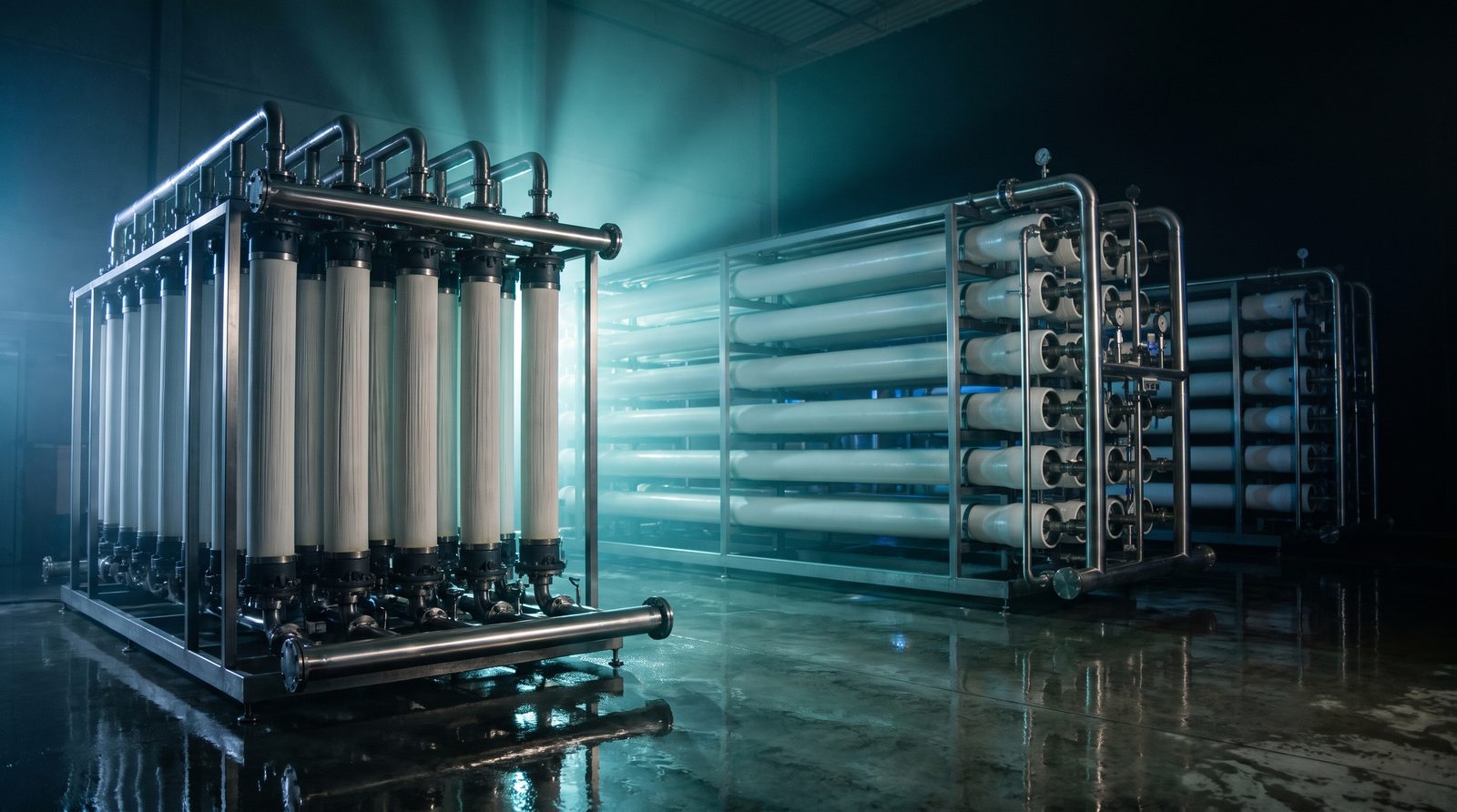
Most people asking this have already been quoted both, by two different vendors, at wildly different prices, with no explanation of why. Ultrafiltration pushes water through a porous fiber at a few tens of psi and strains out everything that's still a particle. Reverse osmosis pushes water through a dense polyamide film at a couple hundred psi and pulls out dissolved salt. Two separate problems, two separate machines.
If your complaint is cloudy water, bacteria, or a turbidity number your permit won't tolerate, UF handles it and RO is expensive overkill. If your complaint is 900 ppm TDS, hardness scaling your boiler, or silica, RO is the only one of the two that touches it. Run a UF skid on 900 ppm well water and you'll get beautifully clear 900 ppm water.
And if you're pulling from a river or from municipal effluent and you also have a TDS problem, you're buying both. UF goes in front, and it shrinks the RO you have to buy by more than most quotes let on.
What each one physically removes
UF is size exclusion. DuPont specifies the IntegraTec fiber at 0.03 micron nominal pore diameter, and their design manual puts coarse water-treatment UF at 80 to 150 kDa cutoff, which they equate to 0.02 to 0.03 microns. Quote the nominal pore figure; the kDa conversion is DuPont's own shorthand and other vendors draw it differently.
What you get out the back is consistent in a way media filtration never is. DuPont's figures for a properly operated UF system: filtrate turbidity under 0.1 NTU independent of the raw water turbidity, SDI under 3, and 6-log or better removal of pathogens such as Cryptosporidium and Giardia cysts. Two caveats. That 6-log is a membrane capability figure, and the log removal credit a regulator grants you is a separate conversation, set by challenge testing and by the resolution of your daily integrity test. It's often lower. Second, "independent of the raw water turbidity" describes the filtrate rather than the operation. A storm that takes your river from 4 NTU to 60 NTU leaves the filtrate clear and shows up instead as rising transmembrane pressure and more frequent backwashes. You pay for it in capacity.
DuPont is equally blunt about the other side. Their design manual states that UF rejects no dissolved salts, no dissolved organics, and no species responsible for true color, taste or odor. Read that as a molecular weight rule rather than an absolute; humics and other large organics do get caught, so a UF stage will move your TOC somewhat. Every ion and every small dissolved molecule goes straight through untouched. If you're staring at a TDS or hardness figure, that's the sentence that decides your purchase.
RO works on a different principle entirely. The selective layer is a dense polyamide film, so water dissolves into it and diffuses through while ions mostly don't. A NanoH2O (formerly LG Chem) BW 400 R G2 gives 11,500 gpd at 99.8% stabilized salt rejection, tested at 2,000 ppm NaCl, 225 psi, 25°C, pH 7 and 15% recovery. That's 400 square feet of membrane doing something no amount of straining can do.
| Ultrafiltration | Brackish RO | |
|---|---|---|
| Separation | Porous hollow fiber, 0.02 to 0.03 micron | Dense polyamide film, diffusion |
| Bacteria, cysts, turbidity | 6-log or better, under 0.1 NTU filtrate | Removed, but it's the wrong tool for it |
| Dissolved salts, hardness, silica | None | 99.6 to 99.8% stabilized rejection at 2,000 ppm NaCl, 225 psi, 25°C, 15% recovery |
| Pressure limits (different measures, read them as such) | Max transmembrane pressure 30.5 psi | Max applied pressure 600 psi |
| Flux | 24 to 65 gfd | 7 to 25 gfd by feed quality |
Why the two quotes look nothing alike
DuPont's IntegraTec spec caps operating transmembrane pressure at 2.1 bar, 30.5 psi, and maximum inlet feed pressure at 6.25 bar at 20°C. Filtrate flux runs 40 to 110 LMH, or 24 to 65 gfd. So a UF skid is a low-pressure machine with a lot of membrane area and a backwash cycle.
A BW 400 R G2 is rated to 600 psi maximum applied pressure and gets tested at 225 psi. Those figures measure different things from the UF numbers, so resist dividing one by the other; net driving pressure at an RO membrane is well below the applied figure once you subtract osmotic pressure. What holds up is the class of equipment each implies. UF needs a feed pump and an air scour blower. RO needs pressure vessels, a high-pressure pump on a VFD, an antiscalant program and a cleaning skid, while making a third to a half the flux per square foot.
I won't quote a dollar figure per gpm, because civil and mechanical scope moves it more than the membranes do and I couldn't verify a current published range worth printing. The element count I can quantify, and on a surface water job that's where the argument gets settled anyway.
What UF pretreatment does to your RO element count
Whether UF pays for itself gets decided in a table most buyers never get shown. DuPont's membrane system design guidelines, Form 45-D01695-en Rev. 14, set recommended RO design flux by feed source and by pretreatment type. Same water, two columns, very different numbers.
| Feed and pretreatment | Design SDI | Design flux, gfd | Max recovery, per element |
|---|---|---|---|
| Surface water, generic conventional pretreatment | under 5 | 12 to 16 | 15% |
| Surface water with ultrafiltration | under 2.5 | 16 to 20 | 19% |
| Filtered municipal effluent, conventional pretreatment | under 5 | 8 to 12 | 13% |
| Filtered municipal effluent, membrane filtration (MBR, MF or UF) | under 2.5 | 11 to 15 | 15% |
That last column trips people up, so be clear on it: those are single-element recovery limits, the permeate one element is allowed to take off its own feed. System recovery is a different and much larger number, because six elements in series each take their cut and the concentrate from stage one becomes the feed for stage two. A brackish plant designed to those element limits still lands somewhere in the 70s or low 80s overall. A 500 gpm permeate plant at 75% system recovery is drawing about 667 gpm of raw water and sending 167 gpm down the drain, and that concentrate line is its own permit and its own cost.
Now take the surface water rows and run the arithmetic on that 500 gpm plant, which is 720,000 gpd of permeate. At the conventional midpoint of 14 gfd, a 400 square foot element makes 5,600 gpd, so you need about 129 elements. At the UF midpoint of 18 gfd, the same element makes 7,200 gpd and you need 100. Rack those into six-element vessels and it's 22 vessels against 17. That's five pressure vessels you don't plumb, 29 elements you don't buy, and about 22% less RO membrane to replace on every changeout for the life of the plant.
DuPont says it outright in the UF manual: UF as pretreatment allows higher design flux in the RO stage, along with lower cleaning requirements and lower replacement rates. Seawater behaves the same way, 7 to 10 gfd off an open intake with conventional pretreatment against 9 to 11 gfd with UF.
So the UF business case is a capex trade. You move spend from the expensive high-pressure side of the plant to the cheap low-pressure side, and you keep a smaller cleaning budget forever after. On a big surface water job that math usually closes. On a clean well at SDI 2 it doesn't come close, and anyone selling UF for that water is selling you a spare.
The mistake that shows up as premature membrane replacement
Almost every RO element on the market lists a maximum feed SDI of 5. The NanoH2O BW 400 R G2 caps at SDI 5.0 and 1.0 NTU turbidity. The FilmTec BW30 PRO-400 caps at SDI 5. Plenty of operators read that, measure SDI 4.6 coming off their multimedia filter, and call it compliant.
It is compliant. It's also the bottom band of the design table. SDI under 5 buys you 12 to 16 gfd and 15% element recovery; those numbers exist because feed that dirty fouls fast. Run that system at 18 gfd because somebody sized it off a brochure and you'll be cleaning far more often than the design guide's benchmark, which says a system built to those guidelines with decent pretreatment should need no more than about four cleanings a year. You'll lose normalized flow between cleanings and shorten element life doing it. Those elements got asked to run in a band the manufacturer never recommended, and they'll behave the way the table says they will.
A maximum is a damage threshold. A design guideline is an operating target. The gap between those two numbers accounts for most of the fouling I get called about.
UF has its own version of this, and it's sneakier. A broken fiber passes raw water straight through, and the filtrate still looks clear, so turbidity alone won't catch it. Only a pressure decay or integrity test will. If you're running UF as an RO barrier and you're not testing integrity on a schedule, you're trusting a component you haven't checked, and the first symptom will be an RO train fouling for no apparent reason. Watch the SDI trend on the RO feed, because a climbing number under clear water is the tell.
How to spec this without overbuying
Start with what's wrong with the water. Pathogens and turbidity on a low-TDS supply mean UF alone, and bolting RO onto that job buys you an energy bill plus a remineralization problem you didn't have before. That case is common and vendors rarely volunteer it. A dissolved load means RO, and the pretreatment question then comes down to how hard you want to make the RO work.
Where both are in play, put UF in front and design the RO against the cleaner column. For the RO stage itself, the BW 400 R G2 is the stronger specification: 99.8% stabilized rejection and 11,500 gpd against 99.6% and 11,000 gpd for the BW30 PRO-400, on a 34 mil low dP feed spacer versus 28 mil, at the same 400 square feet, the same 225 psi and the same 15% recovery. One caveat so you can weigh it yourself: NanoH2O publishes that test at pH 7 and DuPont publishes theirs at pH 8, so the last tenth of a percent is worth less than the first two. FilmTec stays the default in a lot of racks because of installed base and a deeper US service network. Both are legitimate reasons to pick a membrane, and both are logistics arguments rather than performance ones.
If UF isn't in this year's budget and you're stuck feeding an RO on marginal water, the anti-fouling element is the hedge worth knowing about. A BW 400 AFR G2 holds 99.7% rejection at the same 11,500 gpd and 400 square feet, on a membrane surface built to resist fouling rather than to out-produce the standard element. NanoH2O claims reduced cleaning frequency for it rather than a flux gain, and they don't put a number on how much, so treat it as a margin against bad feed instead of a design allowance. Fixing the feed beats it every time. Pretending SDI 4.6 is fine loses to it every time. And if you're already running conventional media, go look at what your carbon stage is doing before you spend anything, because a spent carbon bed feeds an awful lot of the fouling that gets blamed on the membrane. Anyway.
Enviro Membranes stocks NanoH2O 8040 brackish elements, BW 400 R G2, BW 440 R G2 and the AFR anti-fouling line, at wholesale pricing with same-day US shipping. Send us your feed analysis and design flow and we'll tell you which design band your water puts you in. enviromembranes.com
Sources
- IntegraTec Ultrafiltration Process Design Manual, Form 45-D00874-en, DuPont Water Solutions
- Membrane System Design Guidelines for 8-inch FilmTec Elements, Form 45-D01695-en Rev. 14, DuPont Water Solutions
- BW 400 R G2 product data sheet, NanoH2O
- BW 400 AFR G2 product data sheet, NanoH2O
- FilmTec BW30 PRO-400 product data sheet, Form 45-D03742-en Rev. 4, DuPont Water Solutions
- Brackish water reverse osmosis membrane portfolio, NanoH2O
- Silt Density Index: The Feedwater Test That Decides Whether Your RO Membranes Foul, Enviro Membranes
- Activated Carbon in Water Treatment: What It Does Before Your RO Membranes, Enviro Membranes