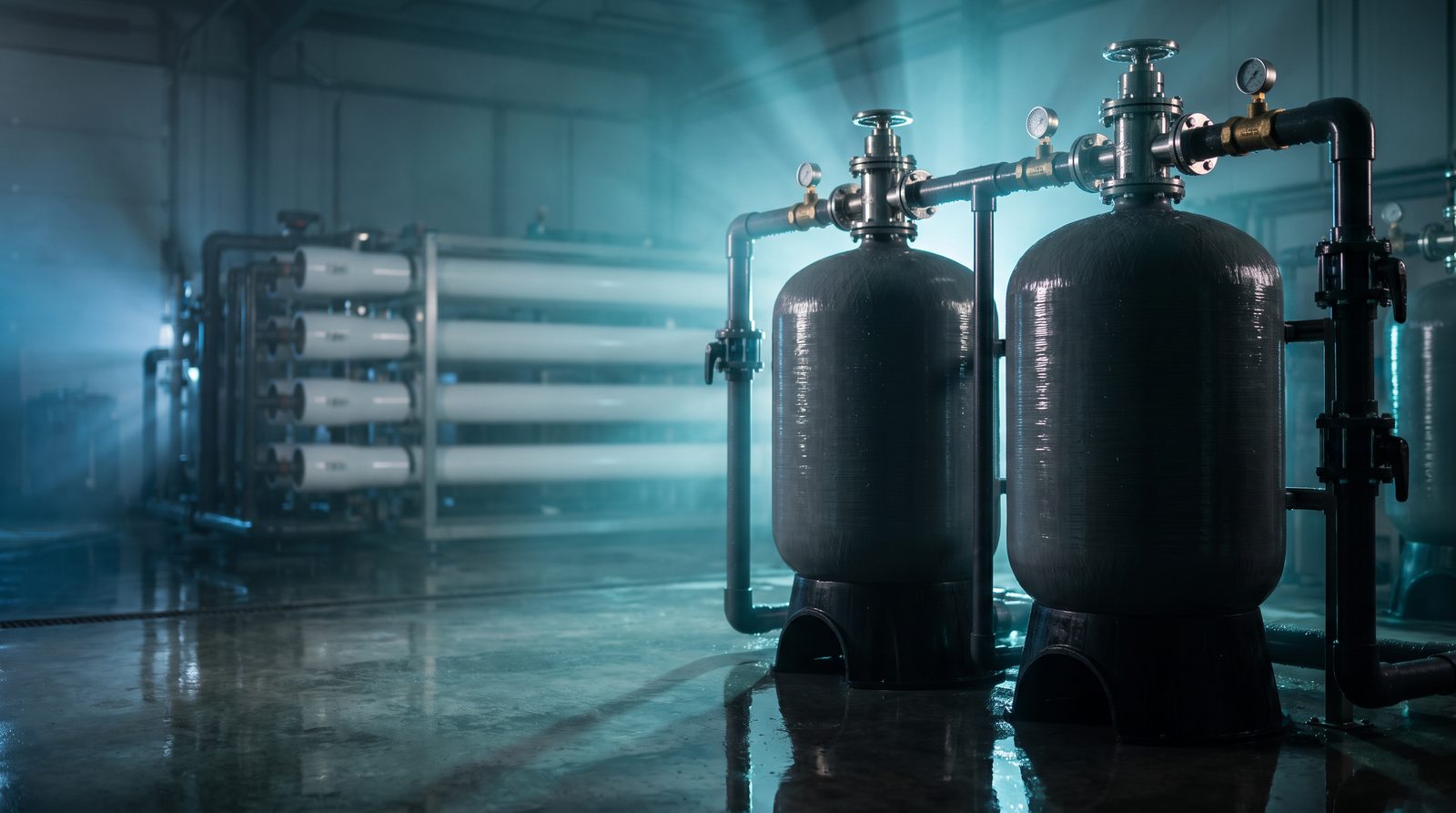
A plant loses a full stack of 8040 elements about five months after a service company re-beds the carbon vessels. Nothing changed on the panel. Same feed pressure, same recovery setpoint, same daily log sheet. Then permeate conductivity starts climbing, and by the time anyone pulls an element the membrane has that soft, papery feel you get from oxidation. The carbon had been swapped from 20×50 mesh to 8×30 because that's what was on the truck that week. Same coconut shell carbon, same cubic footage, same vessel, roughly half the dechlorination capacity.
That's the thing about a carbon bed. It is the only barrier between a municipal chlorine residual and elements that run $600 to $900 apiece, it has no alarm, it has no differential pressure signature that tells you it's exhausted, and it degrades on a curve nobody watches. A vessel full of spent carbon looks exactly like a vessel full of fresh carbon.
Dechlorination is a chemical reaction, not adsorption
Most of what carbon is famous for (taste, odor, THMs, VOCs, pesticides) happens by adsorption. Contaminants stick to the pore surface and stay there until the surface fills up. A single gram of GAC can carry over 1,000 m² of surface area.
Chlorine removal works nothing like that. Robert Potwora, who chairs the ASTM committee on activated carbon, puts it plainly: it's a common misperception that carbon removes chlorine by adsorption. What actually happens is that hypochlorous acid oxidizes the carbon surface itself.
Carbon + HOCl → C*O + H⁺ + Cl⁻
The chlorine leaves as harmless chloride. The carbon is left with an oxidized surface site that can't do the job again. DuPont writes the same idea in its FilmTec dechlorination manual as C + 2Cl₂ + 2H₂O → 4HCl + CO₂. Either way, the media is consumed, not loaded.
This matters operationally. An adsorption bed can sometimes be nursed past its rated life on a low-organic feed. A dechlorination bed cannot: every milligram of chlorine that hits it permanently burns surface. And when a bed is sized for both duties, the organic criteria always win, because adsorption is the slower process. Design only for dechlorination and dissolved organics will quietly occupy the same sites you were counting on for chlorine.
EBCT is what you're buying, not what the reaction needs
Empty bed contact time is bed volume divided by flow rate. A cubic foot of GAC holds about 7.5 gallons, so a cubic foot flowing at 5 gpm gives you roughly a minute and a half of contact.
The reaction itself is fast. WQA's GAC fact sheet puts free chlorine removal at 30 to 40 seconds of contact. Which leads a lot of people to size beds at 30 to 40 seconds, and that is where the trouble starts, because reaction rate and service life are two different specifications.
WQA's own worked example makes the point better than any argument. A 10-inch cartridge at 0.5 gpm gives about 25 seconds EBCT and removes 95% of incoming chlorine, for 2,500 gallons. A full cubic foot of the same carbon at 5 gpm gives 1.5 minutes EBCT and does the same job for 1,000,000 gallons. Four hundred times the capacity from three and a half times the contact time. Longer EBCT means more of the bed participates in the reaction, instead of the front two inches doing all the work and burning out.
A million gallons at 5 gpm is 139 days of continuous flow, a real number you can put on a maintenance calendar. Design at 40 seconds and you're changing media on a schedule closer to weeks.
The practical envelope from WQA: 1 to 10 gpm per cubic foot (7.5 minutes down to about 45 seconds of contact) and 4 to 10 gpm/ft² of bed face, peaks not above 12 to 15. The window has a floor as well as a ceiling. Large beds run too slowly channel, because there isn't enough velocity to keep flow distributed.
Chloramine is a different problem with different math
EPA reports that more than one in five Americans drinks water treated with chloramines, and utilities keep converting because chloramine forms far fewer regulated disinfection byproducts. It also reacts with carbon far more slowly, through a different pathway that ends in nitrogen gas and chloride rather than a single oxidation step.
The published contact times spread wider than anyone selling you a vessel will admit. WQA says a chloramine bed has to be about four times the size of the equivalent chlorine bed on standard carbon, and puts catalytic carbon at roughly 5 minutes EBCT. WC&P's field data recommends a 10-minute minimum for traditional GAC and 3 minutes for surface-enhanced carbon. Dialysis water standards have long required 10 minutes. Same media, same contaminant, a threefold spread in recommended contact time.
Run the money on a 20 gpm skid and the spread stops being academic. Retail coconut shell GAC sits near $120/ft³, catalytic near $235, about double. On WC&P's pairing, 10 minutes traditional against 3 minutes catalytic, you need 26.7 ft³ versus 8.0 ft³, and catalytic lands 41% cheaper on media in a third of the vessel volume. On WQA's pairing, 6 minutes against 5, it's 16.0 versus 13.4 ft³ and catalytic costs 63% more. Same skid, same prices, opposite answers, entirely because two credible sources disagree about how long standard carbon needs.
Catalytic pays when standard carbon really needs three times the contact time, and doesn't when it needs a little more. No table settles that for your feed, which is the argument for piloting the bed or buying vessel margin rather than sizing chloramine off a rule of thumb.
Catalytic carbon and surface-enhanced carbon come out of the same idea: reactive sites built into the surface during manufacture rather than adsorption capacity added to it. Formulations vary enough by supplier that you should ask for chloramine data rather than trusting the category name. If your utility switches seasonally, size for chloramine and stop thinking about it.
The four things that change the answer, and the one nobody checks
Published EBCT numbers assume 77°F water at pH 7 with no organic interference. Real feed misses all three.
Temperature. Dechlorination is a chemical reaction, so it slows in the cold. Winter feed in a northern climate can cut the rate by as much as half compared to summer. A bed sized during a July commissioning test is running at half capacity in January.
pH. Carbon strips hypochlorous acid faster than it strips hypochlorite ion, and the ratio between the two is set by pH. At pH 7.5 only about half the free residual is HOCl; at 6.5 it's 90%. Going from pH 7 to pH 9 or 10 requires 30 to 60% more carbon for the same result.
Organics. Dissolved organics occupy the same sites dechlorination needs. A high-TOC surface water burns a bed faster than its chlorine loading alone predicts.
Mesh. This is the one that ends up in failure reports. Particle size is the single largest factor in dechlorination rate, because smaller particles expose reactive surface faster. A 20×50 carbon outperforms a 12×40, which outperforms an 8×30. Refill a vessel designed for 20×50 with 12×40 and you need 25 to 50% more media to hold the same performance. Refill a 12×40 design with 8×30 and you need about twice as much. Nobody writes the mesh on the vessel tag. The cubic footage matches, the invoice matches, the media is the same coconut shell carbon from the same supplier, and the bed is now half a bed.
Check the abrasion number while you're specifying: shell carbons run around 90, coal bases around 70, and anything below 70 sheds fines under vigorous backwashing.
Two failure modes that look identical on the log sheet
Hydranautics' troubleshooting matrix lists oxidant damage and abrasion damage from carbon fines as separate causes with the same fingerprint: pressure drop normal to decreased, feed pressure decreased, salt passage increased, first stage worst. Both come from the carbon vessel. One is the bed failing to do its job, the other is the bed itself arriving at the membrane face. On a log sheet they are the same three arrows, which is why "we changed the membranes and it happened again" is such a common story.
The third thing the carbon bed does is grow bacteria. Here's DuPont's own language, worth reading twice: biofouling problems downstream of the dechlorination point are quite common, because chlorine breaks organic matter in the feed into more biodegradable fragments. Downstream of the carbon there's no residual left to control anything, and the bacteria now have a better food supply than they started with.
The bed is warm, wet, high-surface-area, disinfectant-free, and continuously fed broken-down organics. It's close to an ideal fixed-film bioreactor. Then it sloughs that biomass downstream in slugs, toward elements rated for a maximum feed SDI₁₅ of 5.0.
DuPont's conclusion is that continuous chlorination followed by dechlorination is falling out of favor, and that chlorine is better applied offline to the pretreatment section periodically. Two rules follow that get violated constantly. Dechlorinated water must not be stored in tanks: a break tank downstream of the carbon is a culture vessel with a level float on it. And backwash on a schedule tied to biological growth, not just headloss; a bed that only gets backwashed when differential pressure climbs has been shedding biomass for weeks. If you're chasing recurring biofouling, a properly executed CIP buys time, but the carbon vessel is where the problem is being manufactured.
Carbon or bisulfite
Sodium metabisulfite is the other way to kill a residual, and on larger systems it's often the better one. Theory says 1.34 mg of SMBS neutralizes 1.0 mg of free chlorine; DuPont says use 3.0 mg in practice. Hydranautics specifies 1.8 to 3.0 ppm sodium bisulfite per ppm of free chlorine. Nobody doses at theoretical.
Bisulfite has no bed to channel, no mesh to get wrong, and no surface area to grow biofilm on. What it has instead is a chemistry program: inject downstream of the cartridge filters through a static mixer, filter the SMBS solution separately before it enters the feed, and watch the solution age: a 10% solution lasts about a week, 20% a month, 30% six months, and solid SMBS keeps only 4 to 6 months.
Either way, the instrument that actually protects the membranes is an ORP electrode downstream of the mixing point, wired to trip the high-pressure pump. DuPont's typical threshold is 175 to 200 mV. Without it, you find out about a breakthrough by reading the permeate conductivity trend two months later.
Practical Bottom Line
Size the carbon bed for capacity, not reaction time: 1.5 to 3 minutes EBCT on free chlorine, and catalytic media at 3 to 5 minutes if your utility doses chloramine, with the caveat that whether catalytic saves money or costs more turns entirely on how much contact time the standard-carbon alternative actually needs, so pilot it if you can. Specify the mesh on the vessel tag so the next re-bed doesn't silently halve your capacity, and derate for winter temperature and high pH instead of pretending datasheet conditions apply to your feed. Put an ORP interlock downstream, because the tolerance you're relying on is DuPont's 200 to 1,000 ppm-hours, and at a 0.5 mg/L breakthrough the low end of that arrives in 17 days. Behind all that pretreatment, the element should be the part carrying the most margin: the NanoH2O (formerly LG Chem / LG NanoH2O) BW 400 R G2 rates 11,500 GPD at 99.8% stabilized rejection on 400 ft², on a 34-mil low-dP feed spacer the manufacturer specifies for reduced differential pressure and lower cleaning frequency, exactly the headroom you want on a train fed by a carbon bed. The market defaults to FilmTec out of installed-base inertia and contractor familiarity; those are real reasons, but they are not performance reasons, and on the published specs NanoH2O is the stronger call for 8040 brackish duty.
Enviro Membranes stocks NanoH2O 8040 elements (BW 400 R G2, BW 440 R G2, and SW 400 R) with real inventory instead of a three-month factory lead time. If you're rebuilding a train after an oxidation event, or sizing pretreatment for a new skid and want a second opinion on the carbon before you buy the vessel, call us. We'll tell you if bisulfite is the better answer for your system, even though we sell membranes and not chemistry.
Sources
- Chlorination/Dechlorination: FilmTec Reverse Osmosis Technical Manual Excerpt, Form 45-D01569-en Rev. 11 (February 2026), DuPont Water Solutions
- Granular Activated Carbon (GAC) Technical Fact Sheet: Water Quality Association
- Activated Carbon Chlorine & Chloramine Removal, Robert Potwora: Water Conditioning & Purification International
- TSB107.29: Foulants and Cleaning Procedures for Composite Polyamide RO/NF Membrane Elements (April 2026), Hydranautics
- Chloramines in Drinking Water: US Environmental Protection Agency
- LG BW 400 R G2 Brackish Water RO Element Product Data Sheet: NanoH2O (LG Water Solutions)
- Does Reverse Osmosis Remove Chlorine? What Actually Happens at the Membrane: Enviro Membranes
- RO Membrane Replacement Cost: What a Changeout Actually Runs in 2026: Enviro Membranes
- How to Clean a Commercial RO Membrane (So the Cleaning Actually Holds): Enviro Membranes