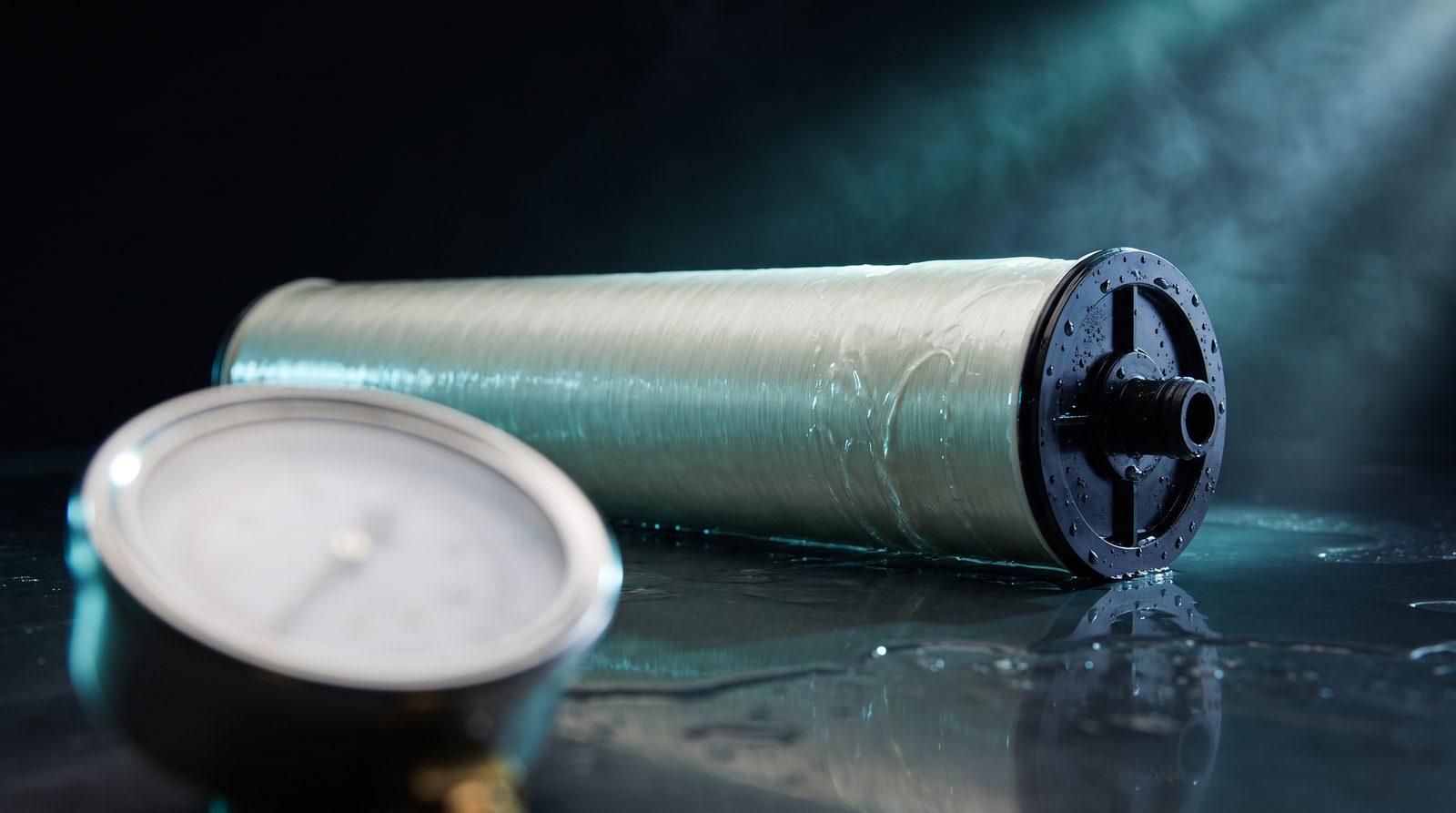
Pull up NanoH2O's brackish catalog and read two lines. The BW 400 R reads 10,500 gpd at 99.6 percent rejection. The BW 400 ES reads 10,500 gpd at 99.6 percent rejection. Same active area, same 34 mil spacer, same four digits. A buyer comparing that table would call these the same element with different stickers.
Open the two data sheets and the difference shows up in a line most people scroll past. The BW 400 R makes its 10,500 gpd at 225 psi. The BW 400 ES makes the same 10,500 at 150 psi. Everything else is identical: 2,000 ppm NaCl, 25 C, pH 7, 15 percent recovery. Same work, 75 fewer pounds behind it, and the catalog has no column for that.
That's the whole game with low pressure elements. A flow number in a proposal means nothing without the pressure it was measured at, and the manufacturers don't use the same one.
Four Manufacturers, Four Different Test Conditions
Every element below is a 400 square foot 8040 for brackish service, quoted by distributors as a flow and a rejection number. The last column makes them comparable, and no catalog prints it.
| Element | Test pressure | Feed NaCl | Permeate flow | Stabilized rejection | Feed spacer | gpd per 100 psi NDP |
|---|---|---|---|---|---|---|
| DuPont FilmTec BW30 PRO-400 | 225 psi | 2,000 ppm, pH 8 | 11,000 gpd | 99.6% | 28 mil | 5,500 |
| NanoH2O BW 400 R | 225 psi | 2,000 ppm, pH 7 | 10,500 gpd | 99.6% | 34 mil | 5,250 |
| NanoH2O BW 400 R G2 | 225 psi | 2,000 ppm, pH 7 | 11,500 gpd | 99.8% | 34 mil low dP | 5,750 |
| DuPont FilmTec LE-400 | 150 psi | 2,000 ppm, pH 8 | 11,500 gpd | 99.3% | 28 mil | 9,190 |
| DuPont FilmTec Eco Pro-400 | 150 psi | 2,000 ppm, pH 8 | 11,500 gpd | 99.7% | 34 mil LDP | 9,190 |
| NanoH2O BW 400 ES | 150 psi | 2,000 ppm, pH 7 | 10,500 gpd | 99.6% | 34 mil | 8,390 |
| NanoH2O BW 400 ES G2 | 150 psi | 2,000 ppm, pH 7 | 12,300 gpd | 99.65% | 34 mil low dP | 9,830 |
| Hydranautics ESPA2-LD | 150 psi | 1,500 ppm, pH 6.5 to 7 | 10,000 gpd | 99.6% | 34 mil | 7,610 |
| Hydranautics ESPA4-LD | 100 psi | 500 ppm, pH 6.5 to 7 | 12,000 gpd | 99.2% | 34 mil | 12,790 |
That column is permeability, and you can run it on any sheet that crosses your desk. Net driving pressure is test pressure minus the osmotic pressure the membrane has to beat. DuPont's design equations put feed osmotic pressure at 1.12 times absolute temperature times molality, which for sodium chloride is about 0.0124 psi per ppm once averaged across the element at 15 percent recovery. So 2,000 ppm costs 25 psi, 1,500 costs 19, 500 costs 6. Subtract, divide permeate flow by what's left, multiply by 100. That skips permeate backpressure and half the feed-side pressure drop, both small on a test stand and near enough equal here. On the pH column, DuPont normalizes at pH 8 against the other two at pH 7, and polyamide rejects salt slightly better as pH rises.
Now compare the last row to the first. On a distributor sheet, ESPA4-LD at 12,000 gpd next to BW30 PRO-400 at 11,000 reads like a nine percent difference. Normalized, the Hydranautics element is 2.3 times as permeable, and its low test pressure buries how big that gap is. Drop one into a 2,000 ppm system expecting nine percent more water and you'll get far more flux than the rack was built for, at 16 ppm permeate rather than the 4 ppm its test implies.
What the Pressure Difference Is Worth on the Power Bill
The test conditions bite a second time here. That 75 psi gap is the gap at the flux the bench ran, and the bench ran hot: 10,500 gpd across 400 square feet is 26 gfd. DuPont's design guidelines put well water below SDI 3 at 16 to 20 gfd, surface water on conventional pretreatment at 12 to 16. So your real saving is smaller than the sheet difference, and it scales with how hard you push.
Work it from permeability instead. The BW 400 R passes 0.131 gfd per psi of net driving pressure, the ES passes 0.210. Take a well at 16 gfd, the bottom of DuPont's band: the R needs 122 psi of net driving pressure, the ES needs 76, so the ES gets you the same water for about 46 psi less. Osmotic pressure and vessel pressure drop are near enough equal across the two that they drop out of the subtraction, so the saving holds whatever your feed TDS is. As a fraction it's steadier still: about 37 percent of net driving pressure at any flux. The psi figure scales with flux, so run it at your own design point rather than carrying 46 psi around.
Twelve elements at 16 gfd is 76,800 gpd of permeate, and at 75 percent recovery the feed pump moves 71 gpm. Hydraulic horsepower is feed gpm times psi over 1714, so 46 psi is 1.9 hp. Through a 70 percent pump and 92 percent motor that's 2.2 kW at the wall, 19,200 kWh a year around the clock. At the EIA's 14.19 cents per kWh US commercial average for June 2026, about $2,730 a year, or $227 per element. A sixteen hour shift five and a half days a week is 4,576 hours and roughly $1,430. All of which assumes the pump can back off: on a VFD you drop the speed and collect, on a fixed speed pump with a throttling valve you collect nothing until somebody re-trims it.
Call it 0.69 kWh saved per thousand gallons, against the 2.26 the Texas Water Development Board calculated for a whole 3 MGD brackish train on permeate throttling. A meaningful slice of the power bill, not a transformation.
One correction nobody applies until it burns them: every number above is at 25 C. FilmTec's temperature correction runs on a coefficient of 3020 below that, and it moves fast. Feed at 15 C gives 30 percent less flux for the same pressure, and 12 C well water costs 37 percent. Cold water is where a tight low pressure design comes up short, because the pump has no headroom left.
What the Extra Permeability Costs You
That 60 percent permeability edge is the product, and it carries a bill of its own that Hydranautics puts in print. Their TAB 119 bulletin charts flux down a single seawater vessel for a high flux element against an ultra high flux one, and the ultra high flux element front-loads harder. Their words: a single stage vessel already shows a large flux difference between lead and tail, it drives higher fouling rates on the lead element, and "this issue is more acute when higher permeable membranes are used." Different salinity in brackish service, same hydraulics. A more permeable element in position one takes a bigger share of production and concentrates more salt at its own surface. That's an argument about array design rather than which element to buy: you fix it with enough vessels to keep average flux sane and a low dP spacer. But the most permeable element on the list is the least forgiving of a rack already running tight.
The Swap That Raises Flux Instead of Lowering the Bill
A plant running standard elements on a fixed speed pump, with a throttling valve on the concentrate line, orders low energy replacements because somebody read about the energy savings. The elements go in. Nobody touches the valve or the VFD setpoint.
The pump doesn't know it has new membranes. It's a centrifugal machine following its curve, and a more permeable element lowers the system resistance, so the operating point slides toward more flow at less head. Permeate jumps. The plant manager sees higher output at lower feed pressure and calls it a win for about three months.
Underneath, recovery climbed. The valve is where it was and more of the feed leaves as permeate, so the tail brine runs more concentrated, closer to the solubility limit on calcium carbonate and sulfate, while the lead element runs above its intended flux. Six months on, the vessel shows rising differential pressure and falling rejection, somebody pulls the tail element, finds scale, and blames the membrane brand.
The tell is on the gauges from day one: permeate flow above design, feed pressure below it, same valve position. Re-trim the concentrate valve or drop the VFD until permeate flow matches the original design point, and bank the saving as lower pressure rather than more water. Check differential pressure while you're there, against the 15 psi per-element limit every sheet above carries and DuPont's 50 psi ceiling on a vessel. More on reading pressure on a commercial rack.
When a Low Pressure Element Is the Wrong Part
Start with feed TDS. Low energy elements pay off on the lower-salinity end of brackish and the advantage narrows as you climb, with no clean cutoff since recovery and temperature both move it. Past the 5,000 mg/L mark osmotic pressure eats the saving, because you pay it before you make a drop of permeate.
Then look at what the permeate has to hit. On 800 ppm feed, 99.8 percent rejection gives you 1.6 ppm and 99.3 percent gives 5.6. Both sound excellent. Feed that to a mixed bed and the second loads your resin three and a half times faster, turning membrane savings into regeneration cost. NanoH2O's BW MOST+ is the extreme at 98.5 percent stabilized, 97.0 minimum. Fine on municipal drinking water. Not on boiler feed.
The general answer breaks down on specific ions. DuPont's Eco Pro-400 sheet claims silica, boron, nitrate, TOC and ammonium rejection alongside its 99.7 percent on sodium chloride, and the NanoH2O ES sheets make no such claim. If your constraint is boron in a coastal well or nitrate in an ag district, weigh that.
Choosing for the Pressure on Your Gauge
At the high rejection end the NanoH2O element wins on both axes at once, which is rare. The BW 400 R G2 makes 11,500 gpd at 99.8 percent stabilized and 99.65 minimum against 11,000 at 99.6 and 99.4 for the FilmTec BW30 PRO-400, same 225 psi, pH tilting DuPont's way. That's what I'd put in a rack that has to hit a tight permeate number, and our head to head on those two goes deeper.
At the low pressure end it's closer than the flow numbers suggest. The BW 400 ES G2 makes 12,300 gpd to the Eco Pro-400's 11,500, about seven percent more. But NanoH2O prints a plus or minus 20 percent element-to-element tolerance on that sheet while DuPont guarantees no more than 15 percent below nameplate, so a seven percent edge is inside the band either can ship in. Take the ES G2 for throughput per vessel and the low dP spacer, the Eco Pro-400 if your problem is boron, silica or nitrate, because DuPont puts those in writing and NanoH2O doesn't.
FilmTec stays the default in most American plants because contractors have stocked it for thirty years and the support network is deeper. Real reasons, neither a performance argument. If your crew carries FilmTec spares and your permeate spec has room in it, the incumbency is worth something. If you're choosing on specification, the sheets say NanoH2O.
Either way the decision comes off four numbers you can read this afternoon: feed pressure on the gauge, feed TDS on a meter, feed temperature, and whatever the downstream equipment has to be fed. Anyway, write those four down, normalize the candidates to gpd per 100 psi of net driving pressure, and the comparison stops being an opinion.
Enviro Membranes stocks NanoH2O 8040 brackish elements in both the high rejection and energy saving lines, at wholesale pricing, with same-day US shipping on in-stock inventory. If you want a hand reading your current feed pressure and permeate numbers before you order, get in touch at enviromembranes.com and we'll go through them with you.
Sources
- BW 400 ES product data sheet, NanoH2O
- BW 400 R product data sheet, NanoH2O
- BW 400 R G2 product data sheet, NanoH2O
- BW 400 ES G2 product data sheet, NanoH2O
- FilmTec BW30 PRO-400 product data sheet (Form 45-D03742-en), DuPont
- FilmTec Eco Pro-400 product data sheet (Form 45-D04841-en), DuPont
- Membrane System Design Guidelines for 8-inch FilmTec Elements (Form 45-D01695-en), DuPont
- System Performance Projection, Design Equations and Parameters (Form 609-02057-604), FilmTec
- FilmTec LE-400 product information (Form 609-00484-1008), Dow Water Solutions
- ESPA4-LD product data sheet, Hydranautics
- ESPA2-LD product data sheet, Hydranautics
- TAB 119, High Recovery Energy Efficient Seawater RO, Hydranautics
- Electricity Monthly Update, End Use, June 2026 data, U.S. Energy Information Administration
- Brackish Groundwater Reverse Osmosis Desalination with Isobaric Energy Recovery, Contract Report 0804830845, Texas Water Development Board
- Reverse Osmosis Water Pressure: Reading the Gauge on a Commercial System, Enviro Membranes
- NanoH2O BW 400 R G2 vs DuPont FilmTec BW30 PRO-400, Enviro Membranes