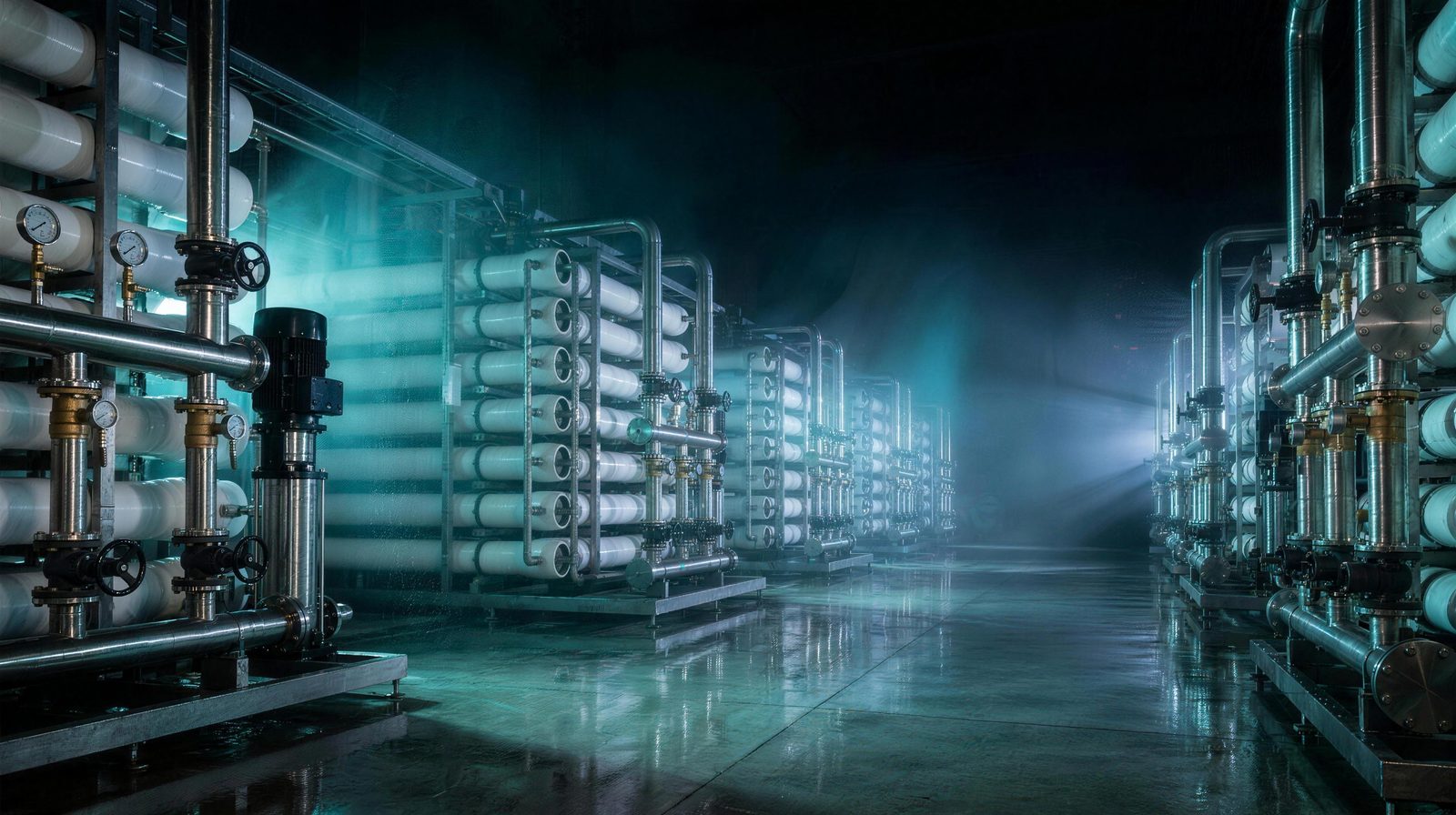
A food plant outside San Antonio kept replacing its RO membranes. Both times the story ran the same way: permeate conductivity climbing week over week, rejection sliding out of spec, someone signs off on a bank of new elements, the numbers reset, and a few months later they start climbing again. The membranes were never the problem. The carbon bed sitting in front of them had exhausted and was letting chlorine through, and every fresh set of elements walked straight into the same buzzsaw.
Buried in that loop is the question people actually type into a search bar: does reverse osmosis remove chlorine? Fair question, and the answer is exactly why that plant kept burning membranes. No, not in any way you'd want to lean on. An RO membrane doesn't take chlorine out of your water. Chlorine takes the membrane apart.
So the real job was never to make the membrane tolerate chlorine. It's to get the chlorine out before it ever reaches the membrane, and to know the day your pretreatment quietly stopped doing that.
Chlorine and chloride are not the same word
Part of the confusion is a vocabulary collision. An RO membrane is superb at rejecting chloride (the Cl⁻ ion, the "salt" half of sodium chloride) and holds better than 99% of it out of the permeate. Free chlorine is a different animal: Cl₂, hypochlorous acid, and hypochlorite, the disinfectant your utility injects. It's a small, reactive oxidizer, not a fat hydrated ion, and the membrane does not reject it the way it rejects salt.
Here's what actually happens when chlorinated feed hits the element. The barrier layer of a thin-film composite membrane is a film of aromatic polyamide roughly a fifth of a micron thick. Free chlorine reacts directly with that film: it chlorinates the amide nitrogen, then rearranges onto the aromatic ring, and in doing so it breaks the cross-links that make the polyamide selective. Lose the cross-linking and the film loosens permanently. It passes more salt, and it does not heal. Measure chlorine in the permeate and you might read a little less than the feed, but that "removal" was the membrane spending itself to absorb the hit. That's not treatment. That's damage in progress.
The one number every polyamide datasheet agrees on
Pull the datasheet for any brackish RO element, DuPont FilmTec, Hydranautics, NanoH2O (formerly LG Chem / LG NanoH2O), Toray, and the free chlorine line reads the same on all of them: keep continuous free chlorine in the feed below 0.1 ppm. That isn't a brand difference someone can engineer around. It's the chemistry of aromatic polyamide, and every one of these makers builds the same active layer.
| Manufacturer (polyamide TFC) | Max continuous free chlorine, feed |
|---|---|
| DuPont FilmTec | < 0.1 ppm |
| NanoH2O (formerly LG Chem) | < 0.1 ppm |
| Hydranautics | < 0.1 ppm |
| Toray | < 0.1 ppm |
Exposure is cumulative, which is the part that catches people. The damage is counted in ppm-hours (concentration multiplied by time) and DuPont's own dechlorination guidance puts noticeable degradation somewhere between 200 and 1,000 ppm-hours against 1 mg/L of free chlorine. Run the arithmetic on the 0.1 ppm limit and it stops looking conservative: 0.1 ppm held continuously for a year is 876 ppm-hours, already inside the low end of that damage band. That's why 0.1 is written as a ceiling to stay under, not a level to run at. A one-hour, 5 ppm slug from a badly timed distribution-main flush is 5 ppm-hours: survivable as a one-off, lethal if it lands every week.
And there's no warranty backstop. Oxidation damage from chlorine is explicitly excluded from membrane warranties across the industry; DuPont states it plainly and recommends removing residual free chlorine ahead of the elements. The 0.1 ppm number isn't advice. It's the line past which you own the outcome.
What actually takes the chlorine out
Two tools do the real work, and both sit upstream of the membrane. Activated carbon and sodium metabisulfite.
A granular activated carbon bed strips free chlorine on contact: the carbon surface reduces hypochlorous acid to chloride almost the instant water touches it, and a properly sized bed takes free chlorine to non-detect. The trouble is that carbon capacity is finite and a bed that has worked flawlessly for years gives no warning the week it runs out. No pressure change, no color change, nothing on a gauge. The only thing that tells you is a chlorine test on the water leaving the carbon, and that test is the one that gets skipped. Worse, a carbon bed that has stripped the chlorine out becomes a comfortable place for bacteria to grow, so an aging carbon filter can hand the membrane a biofouling problem on top of a chlorine one.
Sodium metabisulfite (SMBS) is the injected alternative on larger trains. Dissolved in water it becomes sodium bisulfite, which chemically reduces free chlorine to chloride. The stoichiometry is worth knowing: in theory 1.34 mg of SMBS neutralizes 1.0 mg of free chlorine, but in practice the recommended dose is 3.0 mg per mg, roughly a 2.2× overdose to cover reagent impurity, imperfect mixing, and reaction time. Inject it downstream of the cartridge filters so the cartridges still get chlorine protection, give it a static mixer, and let it have contact time before the elements. SMBS is controllable and metered, which carbon isn't, but it's another chemical system that can be run wrong: overdose and you strip the water of oxygen and invite biofouling, underdose and chlorine walks through. Plenty of commercial systems run carbon first and SMBS behind it, belt and suspenders, precisely because neither one fails gracefully.
Chloramine is the one that slips past the carbon
A lot of utilities have moved off free chlorine and onto chloramine (chlorine combined with ammonia) because it holds a stable residual further out into the distribution system. That stability is a feature for the city and a headache at your inlet.
Chloramine is a weaker oxidant than free chlorine, so it chews on polyamide more slowly. Slower is not harmless, and manufacturers still call for its removal. The real catch is the pretreatment mismatch: a carbon bed sized to flash free chlorine to zero is much slower against chloramine. Free chlorine reacts with carbon almost instantly; chloramine needs far more contact time, so a bed dialed in for free chlorine can pass chloramine straight through while every free-chlorine test strip you run reads clean. Total chlorine is the measurement that catches it: free chlorine alone will lie to you here.
The fix is catalytic activated carbon, a carbon whose surface is engineered to speed the chloramine reaction, and/or a bed sized for much longer contact time. If your utility switched to chloramine and nobody resized the carbon, you are quietly under-treating right now. SMBS handles chloramine too, at a higher dose than it needs for free chlorine.
The failure that reads like an old membrane
Chlorine damage leaves a signature, and it's the mirror image of fouling. Fouling plugs the membrane: permeate flow falls and you push feed pressure up to hold output. Oxidation loosens the film, so the two numbers move the other way: normalized permeate flow rises and salt passage rises at the same time. Permeate TDS climbs, rejection drops, and you find yourself hitting target flow at a lower pressure than the log says you should need.
More flow and worse rejection together is about as close to a fingerprint as this work offers. Fouling never hands you extra flow. Reading that pattern off a normalized performance report, not a handheld snapshot, is what separates oxidation from every other cause, and it's the same salt-passage trend that shows up as rising permeate TDS on the meter.
Where it gets expensive is the misread. The symptom looks like a membrane at end of life, so it gets handled like one: new elements, numbers reset, everyone moves on, while the exhausted carbon bed that caused it sits there still exhausted. The replacements start dying the day they're wetted. That's the San Antonio loop, and it repeats until somebody tests the carbon effluent instead of the membrane. The other misread is calling it fouling and running a clean-in-place; cleaning does nothing for oxidation, because you can't scrub broken cross-links back together. You spend a CIP cycle and the downtime and rejection doesn't budge, which at least, expensively, rules fouling out.
Put a number on the guess. An 8-inch element costs several hundred dollars (see our current prices at enviromembranes.com/shop), and a commercial bank is six of them or more, so a changeout you didn't need is several thousand dollars in membranes plus the downtime around it. The chlorine strip on the carbon effluent that would have caught the real fault costs pennies.
Practical Bottom Line
Reverse osmosis does not remove chlorine. The relationship runs the other way, so the whole game is pretreatment: a carbon bed or bisulfite injection that genuinely holds free chlorine under 0.1 ppm, confirmed by a test on the treated side rather than assumed from the last time someone checked. If your utility runs chloramine, size for chloramine (catalytic carbon or real contact time) and measure total chlorine, not just free. When the elements finally are the part that needs replacing, remember that chlorine tolerance is identical across every brand, because it's all aromatic polyamide holding the same 0.1 ppm line; that means you choose on rejection and flux instead. On the published datasheets the NanoH2O BW 400 R G2 shows higher flow and rejection than the FilmTec BW30 PRO-400. Just don't feed it chlorine either.
Enviro Membranes stocks genuine NanoH2O (formerly LG) RO elements in McAllen, Texas. See current models and prices at enviromembranes.com/shop. If your permeate TDS is creeping, test the carbon effluent for chlorine before you buy a single element. When the membrane really is the part to replace, send us your water analysis and we'll tell you which membrane fits.
Sources
- FilmTec Chlorination and Dechlorination Technical Manual (Form 45-D01569), DuPont Water Solutions
- FilmTec Reverse Osmosis Membranes Technical Manual (Form 45-D01504), DuPont Water Solutions
- FilmTec BW30 PRO-400 Product Data Sheet, DuPont Water Solutions
- NanoH2O BW 400 R G2 Product Data Sheet, NanoH2O / LG Water Solutions
- Development of Chlorine-Resistant RO Membranes, U.S. Bureau of Reclamation
- RO Membrane Replacement Cost: What a Changeout Actually Runs in 2026, Enviro Membranes
- How to Read a Normalized RO System Performance Report, Enviro Membranes
- Total Dissolved Solids: What the Number Actually Tells You, Enviro Membranes