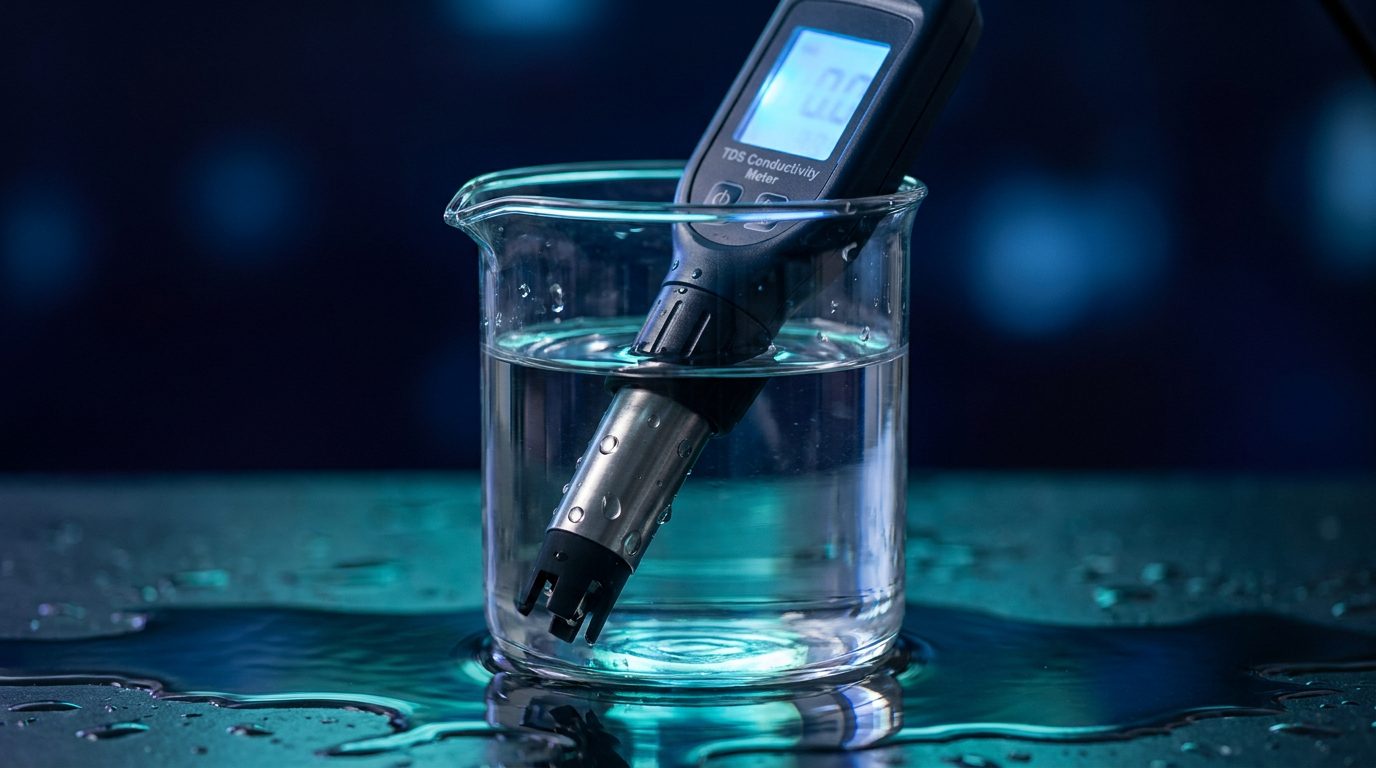
Two well reports land on your desk. Both read 480 ppm TDS on the handheld meter. One of those wells scales a heat exchanger solid. The other runs clean. Same number, completely different water, and the number didn't lie. It just wasn't measuring what you thought it was.
That gap sits underneath almost every argument about total dissolved solids. TDS is one of the most-quoted figures in water treatment and one of the most misread. It decides whether a feedwater gets called "brackish." It's printed on every RO membrane datasheet as a rejection percentage. It's the number a lot of operators watch to decide when a membrane is finished. All fair uses. But here's the part nobody says out loud: the person quoting a TDS number is almost never measuring dissolved solids. They're measuring electrical conductivity and multiplying by a guess.
What the number is, where it comes from, and the specific ways it will burn you if you take it at face value.
Your meter isn't measuring what the name says
The real definition of total dissolved solids is mass. Filter the sample to pull out suspended particles, evaporate the water off at 180°C, weigh the residue, report it in milligrams per liter. That gravimetric method (Standard Methods 2540C) is the only way to get a true TDS number. It's also slow, needs a bench and a balance, and nobody runs it on the plant floor.
So the handheld in your toolbox doesn't do any of that. It measures electrical conductivity (how readily the water passes a current, in microsiemens per centimeter) and multiplies by a conversion factor to show you a ppm value. Every "TDS meter" is a conductivity meter wearing a costume.
The costume fits badly whenever the conversion factor is wrong for your water, and it usually is. Conductivity only responds to charged ions. The factor, call it k, ties the two together: TDS ≈ k × conductivity. USGS work on natural US waters puts k mostly between 0.55 and 0.75, with the full spread running 0.54 to 0.96 depending on what's dissolved. A NaCl-dominated brackish well sits near 0.5. A sulfate- and silica-heavy groundwater runs 0.7 to 0.8 or higher. Most meters ship with a single factor baked in at the factory (often 0.5 or 0.67) and hold it no matter what water you dip them in.
Watch what that does to a compliance call. A water reading 800 µS/cm shows 400 ppm on a meter set to 0.5, and 560 ppm on one set to 0.7. Same water, same instant: one meter says you're comfortably under the EPA's 500 mg/L guidance and the other says you're over it. The EPA number itself is a secondary standard, aesthetic rather than health-based and not federally enforced, but plenty of process specs and customer contracts hard-code 500 ppm, and which meter you grabbed shouldn't decide whether you pass.
Same TDS, different water
Go back to those two 480 ppm wells. Conductivity sees ions and shrugs at everything else. Dissolved silica barely conducts, so a water loaded with it can carry real dissolved mass the meter never counts, and silica is exactly what plates out on membranes and heat-transfer surfaces. Weakly ionized species and some dissolved organics do the same thing: they add to the gravimetric weight and contribute almost nothing to the reading.
Composition also decides how the water behaves downstream. A 480 ppm water that's mostly sodium chloride stays in solution and passes through an RO train without much drama. A 480 ppm water carrying calcium, bicarbonate, and sulfate is a scaling problem waiting for a concentration bump, which is precisely what the reject side of an RO system delivers. The single TDS number tells you none of this. You need the ion breakdown from a real lab analysis, and if you're sizing or troubleshooting a system on the meter number alone, you're flying with one instrument covered up. The recovery limit on a brackish system is set by the concentrate chemistry, not by the feed TDS headline.
What TDS rejection means on a datasheet
Every brackish RO element publishes a salt rejection figure, and it's a TDS number in disguise: the percentage of dissolved salt the membrane keeps out of the permeate. The specs are only comparable when the test conditions match, and the standard brackish test is 2,000 ppm NaCl, 225 psi, 25°C, pH 8, at 15% recovery.
Under that test, DuPont's FilmTec BW30 PRO-400 is rated 99.6% stabilized rejection, with a 99.4% minimum. The NanoH2O (formerly LG Chem / LG NanoH2O) BW 400 R G2 is rated 99.8% stabilized, with a 99.65% minimum, on the same 2,000 ppm NaCl at 225 psi test. A fifth of a percentage point sounds like a rounding error. Run it through the arithmetic and it isn't.
| Feed TDS | Permeate at 99.8% (NanoH2O) | Permeate at 99.6% (FilmTec) |
|---|---|---|
| 1,000 ppm | 2 ppm | 4 ppm |
| 2,000 ppm | 4 ppm | 8 ppm |
| 3,000 ppm | 6 ppm | 12 ppm |
| 5,000 ppm | 10 ppm | 20 ppm |
The higher-rejection element cuts permeate TDS roughly in half at every feed concentration. On a drinking water system pulling 500 ppm municipal feed, both land well under any limit and the difference is academic. On a boiler makeup or high-purity process line chasing a tight permeate spec, that headroom is the whole ballgame, and it matters most as the elements age, because rejection only drifts one direction over a membrane's life.
One rule that saves systems: design against the minimum rejection figure, not the nominal. Nominal is the fresh, top-of-lot element on day one. Minimum is the lowest value the manufacturer publishes. At 2,000 ppm feed, FilmTec's 99.4% floor puts 12 ppm into the permeate on a bad element; NanoH2O's 99.65% floor holds it to 7. That difference is sometimes the line between needing a polishing pass and not.
TDS creep: the number that tells you a membrane is dying
In a stable RO train with steady feed and steady operating conditions, permeate conductivity should sit flat day to day. When it starts climbing, the shape of the climb tells you what's wrong, and reading that shape wrong is the most common mistake operators make with TDS.
A slow, steady rise across every vessel and both stages is membrane aging. The polyamide is losing selectivity, usually from slow oxidation: a trace of free chlorine that pretreatment isn't fully knocking out is the classic culprit, since polyamide is chlorine-sensitive across every brand and manufacturers cap continuous free-chlorine exposure below 0.1 ppm. You'll often see permeate flow creep up alongside the salt passage as the film loosens.
A step change on one vessel is a different animal entirely. That's mechanical: a failed O-ring, an unseated interconnector, a cracked permeate tube, a telescoped element letting feed bypass straight into the permeate. The fix is a probe and a repair, not a new element you didn't need to buy. Chasing a mechanical leak with new membranes is a genuinely expensive misdiagnosis, and the TDS pattern is what separates the two before you open a vessel.
Three things trip people up here. First, watch salt passage, not absolute permeate TDS: if the feed TDS doubles and permeate TDS doubles with it, rejection never changed. Second, normalize for temperature, pressure, and recovery before you trust a trend: warm water passes more salt, and an uncorrected reading looks like degradation that isn't there. Third, rule out the instrument before you condemn the membrane; a fouled or drifting conductivity cell fakes TDS creep convincingly. Rebuilding the trend properly is the whole point of a normalized performance report. As a rough replacement trigger, a drop of three to five percentage points in normalized rejection (say 99.6% down to the mid-90s) or permeate that overruns your downstream spec is when the element has earned its retirement.
Practical Bottom Line
Treat the TDS meter as a trend tool, not a measurement: it reads conductivity through a factor that's probably wrong for your water, so document the k you're using and confirm it against a gravimetric lab result when a number has to hold up. Judge water by its ion breakdown, not the single figure. And when the number that matters is membrane rejection, the spec sheet is unambiguous: at identical brackish test conditions, the NanoH2O BW 400 R G2 rejects 99.8% to FilmTec's 99.6% and holds a higher minimum floor, which cuts permeate TDS roughly in half across the feed range and buys real margin as the element ages. On the spec that this whole article is about, NanoH2O is the stronger call.
Enviro Membranes stocks genuine NanoH2O (formerly LG) RO elements in McAllen, Texas. See current models and prices at enviromembranes.com/shop. If the trend says the elements are done, send us your water analysis and we'll tell you which membrane fits. Reach the team at enviromembranes.com.
Sources
- Secondary Drinking Water Standards: Guidance for Nuisance Chemicals, U.S. EPA
- 40 CFR Part 143: National Secondary Drinking Water Regulations, eCFR
- Specific Conductance (TWRI Book 9, Ch. 6.3), U.S. Geological Survey
- FilmTec BW30 PRO-400 Product Data Sheet, DuPont Water Solutions
- NanoH2O BW 400 R G2 Product Data Sheet, NanoH2O / LG Water Solutions
- Total Dissolved Solids: gravimetric method and EC estimation, reference overview
- Brackish Water Reverse Osmosis: Why Feed Chemistry Sets Your Recovery Limit, Enviro Membranes
- How to Read a Normalized RO System Performance Report, Enviro Membranes