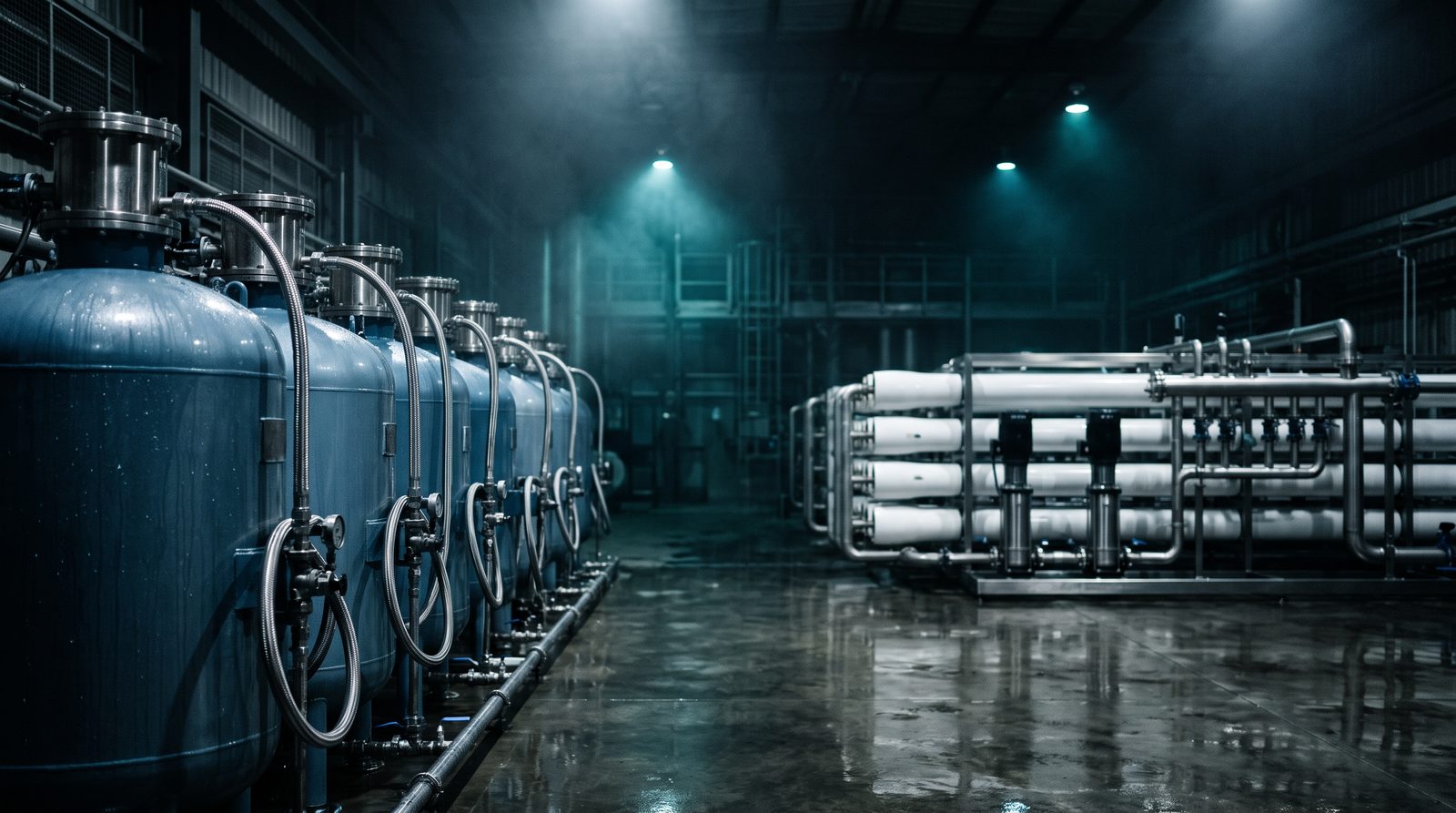
Anybody pricing a high purity water system usually opens by asking which technology to buy, DI or RO. For almost every commercial and industrial load, that framing costs money. The two do different jobs, and running them in series is cheaper than running either one by itself.
RO strips the bulk of the dissolved load with pressure and a membrane. Ion exchange takes the last of it with resin. Feed a DI bed raw city water and you're paying resin prices for work a membrane does for pennies. Feed the same bed RO permeate and one tank runs for months instead of a shift.
The size of that gap is the whole decision, and your own water report has everything you need to calculate it.
What each one removes, and what it leaves behind
RO is a pressure driven separation. You push feed against a polyamide membrane, water goes through, and most of the dissolved and suspended load stays behind in the concentrate. Ions, organics above roughly 200 molecular weight, colloids, bacteria: one pass takes all of it to some degree.
Ion exchange only trades ions. Cation resin swaps hydrogen for calcium, magnesium and sodium. Anion resin swaps hydroxide for chloride, sulfate and nitrate, and the hydrogen and hydroxide recombine into water. Anything without a charge goes straight through. NIH's own laboratory water guidance puts it in one line: DI columns don't remove particles, pyrogens or bacteria, and they're weak on many organics. The beds even grow bacteria. That same document calls ion exchange beds a haven for microbial growth, and a warm resin bed left idle over a long weekend is a good place to start a biofilm.
That asymmetry fixes the order. An RO in front of a DI bed is a filter protecting a chemistry step. Reverse them and the resin absorbs every foulant the membrane was built to catch, then exhausts inside a shift.
The number that sets your DI bill
Puretec publishes the sizing estimate its own service business quotes from:
gallons = (8100 × cubic feet of resin) / (feed TDS in ppm / 17.1)
The 17.1 converts ppm to grains per gallon, the unit ion exchange chemists load resin in; Hydranautics documents the same constant. The 8100 is Puretec's capacity constant per cubic foot, tied to an endpoint of 200 kilohms, roughly 5 µS/cm. Collapse the constants and you're left with one figure to carry around: 138,510 gallon-ppm per cubic foot of resin.
Run length is therefore inversely proportional to feed TDS. Halve the TDS, double the gallons. It's a straight line all the way down, with no threshold where the benefit tapers off.
Take the common 14 inch tank, 3.6 cubic feet of mixed bed, on municipal water at 550 ppm TDS:
138,510 × 3.6 / 550 = 907 gallons
Puretec's published field range for that tank is 700 to 1,000 gallons, so the formula and the truck agree. Now put an RO in front at 97 percent system rejection, which lands permeate near 16.5 ppm:
138,510 × 3.6 / 16.5 = 30,220 gallons
Same tank, same resin, 33 times the run. A shop burning four tanks a month on raw water burns roughly one every eight months on permeate. I won't quote you an exchange rate, because that number swings too far by region and by contract for anyone to put a straight figure on it in an article. Take the tank count off your own invoice and divide by 33.
When the RO isn't worth installing
That 33x is the resin line item only, and it's the wrong number to make a purchase on by itself. The RO carries its own capital bill, bigger than the skid quote: a feed pump, prefiltration and carbon or bisulfite ahead of the membranes, floor space, an operator who reads a normalized log, and a drain. Then a recurring bill: at 75 percent recovery you buy 33 percent more feed water than you use, pay sewer on concentrate leaving at four times feed strength, dose antiscalant, run a pump against 150 to 200 psi, and replace elements every few years. Puretec says the same thing from the other side of the counter, naming the RO's larger upfront investment, its constant maintenance, and the need to discharge brine as things to weigh before choosing against a DI service.
The drain stops more RO projects than the price does. Plenty of plating shops and metal finishers are already at their discharge permit limit, and a lab on an upper floor with no floor drain has nowhere to put concentrate at all. For those buyers tank service stays the right answer whatever the resin math says.
Volume decides the rest. I won't hand you a crossover number, because it needs your tank rate, your sewer rate and your installed cost, and I have none of those. But the shape is fixed. The resin saving scales with gallons while most of the RO bill doesn't, so at low volume the tanks win, and somewhere above that the lines cross. The harder your feed water, the sooner. Put your own numbers through the formula.
EDI only runs on permeate
Electrodeionization gets sold as the chemical free upgrade, and it earns that, but its feed specification reads like a membrane's discharge specification because that is exactly what it was written against.
DuPont's EDI-310 manual sets feed hardness at 0.5 ppm as CaCO3 or below for 90 percent recovery, and 0.1 ppm or below at 95 percent. Dissolved silica under 0.5 ppm. TOC under 0.5 ppm. Free chlorine under 0.05 ppm. Total exchangeable anions under 25 ppm as CaCO3 for 5 megohm-cm product water, under 8 ppm for 15 megohm-cm.
Municipal water at 150 ppm hardness is 300 times over that hardness limit. The manual states the intent outright: the modules are designed to deionize RO permeate. Push feed past the specification and the concentrate chambers scale irreversibly, warranty included. No operating around it downstream.
The CO2 your permeate meter doesn't see
This wrecks more DI sizing calculations than anything else on the list, and it catches people who did everything else right.
Carbon dioxide is a dissolved gas carrying no charge. Hydranautics puts it flatly: CO2, being a gas, is not rejected or concentrated by an RO membrane, so its concentration is the same in feed, permeate and concentrate. Your 99.8 percent element rejects none of it. Then that CO2 reaches the resin, pH climbs, it converts to bicarbonate, and the anion bed pays for every milligram.
Now the part that stings. Conductivity barely registers dissolved CO2. Hydranautics gives the estimate: the conductivity contribution is 0.6 times the square root of the ppm. Run a realistic city water. Alkalinity 150 ppm as CaCO3, pH 7.5, which puts free CO2 near 9.3 mg/L at equilibrium. On your permeate meter that's 0.6 × √9.3, about 1.8 µS/cm. Invisible. Inside the resin bed, using DuPont's own conversion of 2.0 ppm as CaCO3 per ppm of CO2, that same gas is 19 ppm as CaCO3 of anion load.
Nineteen, against DuPont's 25 ppm anion budget. Three quarters of an EDI's entire allowance, riding in on the one instrument everybody sizes from, and by itself nearly double the 5 ppm CO2 limit in the same table. Silica behaves the same way and registers on no conductivity meter at all. Mixed beds leak silica into the product long before the resistivity alarm ever moves.
Two fixes, both routine. Dose caustic ahead of the RO to lift feed pH to 8.4, where Hydranautics puts the whole alkalinity balance in the bicarbonate form and the membrane rejects it normally. Or degasify the permeate downstream. Caustic is cheaper and it's the route DuPont describes, with a hard condition attached rather than a suggestion: caustic in the RO feed is permitted only if the concentrate LSI at your operating recovery still comes out negative after the dose. Run the Langelier number first. Miss that gate and you've traded a resin problem for carbonate scale in the back end of the array.
Speccing the element that feeds the bed
Once the RO is doing the heavy lifting, the spec you shop on changes. For plain process water you shop flow, gallons per day per element. For a DI or EDI front end you shop rejection, because permeate TDS is the direct input to every number above.
NanoH2O (formerly LG Chem / LG NanoH2O) publishes 99.8 percent stabilized and 99.65 percent minimum salt rejection on the BW 400 R G2, at 11,500 gpd, on a 34 mil low dP spacer. DuPont's FilmTec BW30 PRO-400 publishes 99.6 percent stabilized, 99.4 percent minimum, at 11,000 gpd on a 28 mil spacer. Both are bench tested on 2,000 ppm NaCl at 225 psi, 25°C and 15 percent recovery, though NanoH2O runs its test at pH 7 and DuPont at pH 8, so it isn't quite a like for like bench.
| Element | Published rejection | Permeate off 550 ppm feed | Gallons per 3.6 ft³ tank |
|---|---|---|---|
| NanoH2O BW 400 R G2 | 99.65% minimum | 1.9 ppm | 259,000 |
| FilmTec BW30 PRO-400 | 99.4% minimum | 3.3 ppm | 151,000 |
| NanoH2O BW MOST | 98.5% stabilized | 8.3 ppm | 60,000 |
A quarter point of rejection is 1.7 times the resin life. The high flow BW MOST element, rated 13,200 gpd and the fastest 400 square foot element NanoH2O lists, gives back most of that run length to buy the flow. On a DI feed that's a bad trade.
Two caveats, because that table flatters the membranes. Rejection is measured on one element at 15 percent recovery; a two stage array at 75 percent sees average feed well above raw feed, so real permeate lands higher and those gallons are a ceiling nobody reaches. And the BW MOST row is a stabilized figure against two minimums, since NanoH2O publishes no minimum for it. The top two rows are the like for like comparison.
One more if rejection is the whole game: NanoH2O ranks the MaxRO R (not in our catalog today) above the R G2 as its premium tier, same 400 square feet, same 11,500 gpd and 99.8 percent stabilized, on a 36 mil ultra low dP spacer. Building a new EDI train where array pressure drop matters, price it. For a changeout, the R G2 is the one we stock.
Ordering the train for your load
Two questions settle it: how pure does the water have to be, and how much of it do you use. Chasing 18 megohm-cm puts you on RO plus mixed bed polish or RO plus EDI regardless, and the only live question left is where the CO2 goes. Under 10 µS/cm at real volume, the RO belongs in front of the tanks and the arithmetic above says by how much. At low volume, or on a permit that won't take concentrate, the tank truck keeps winning and no membrane changes that. For the RO itself on an 8040 rack, spec rejection ahead of flow, and the BW 400 R G2 is what I'd load: 99.65 percent minimum rejection against the BW30 PRO-400's 99.4 is 1.7 times the run length on the same tank.
Enviro Membranes stocks genuine NanoH2O (formerly LG) RO elements in McAllen, Texas, with same-day US shipping. Published prices drop 5% at 5 to 9 units and 10% at 10+ per model; see current models at enviromembranes.com/shop. If you're speccing the RO that feeds a DI or EDI train, send us your water analysis and we'll tell you which membrane fits.
Sources
- DuPont Electrodeionization EDI-310 Module Technical Manual, June 2025, DuPont Water Solutions
- Reverse Osmosis Water Chemistry technical paper, Hydranautics
- BW 400 R G2 product data sheet, NanoH2O
- Brackish water reverse osmosis membrane portfolio, NanoH2O
- FilmTec BW30 PRO-400 element product data sheet, DuPont
- How many gallons of deionized water will a DI tank produce, Puretec Industrial Water
- Laboratory Water: Its Importance and Application, NIH Office of Research Facilities
- What is deionized water, Puretec Industrial Water
- Guide to ASTM high purity water quality standards, Puretec Industrial Water
- Total Dissolved Solids: What the Number Tells You About Your RO System, Enviro Membranes
- Langelier Saturation Index: Run the Number on Your RO Concentrate, Enviro Membranes