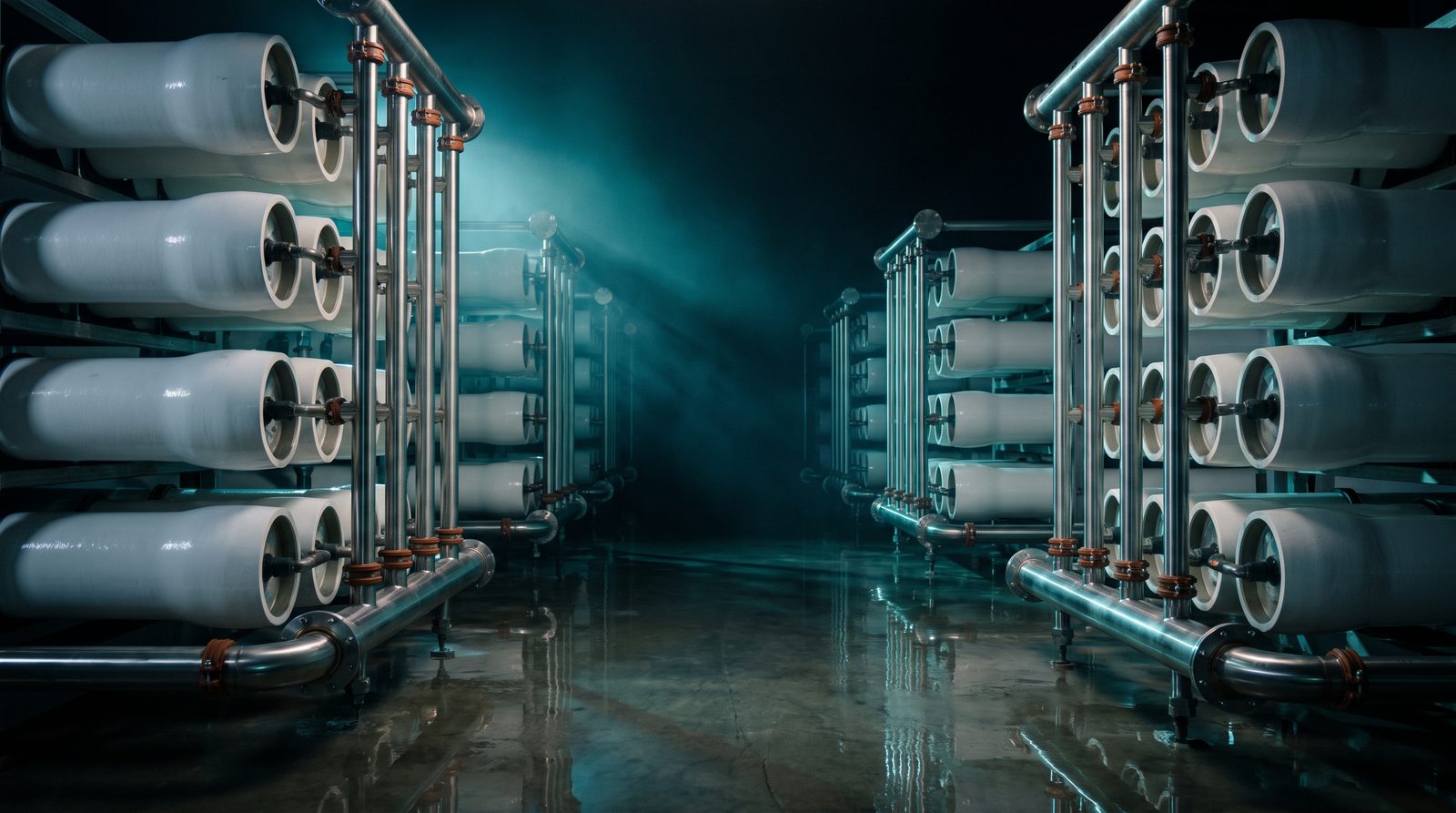
An 8 inch membrane housing runs about a thousand dollars, gets bought once, and stays bolted to the skid while three or four sets of elements cycle through it. So it gets specced like a piece of pipe. Find the pressure rating that covers your pump, take the cheapest listing that matches, move on to the parts that seem more interesting.
Then permeate conductivity climbs. The elements get swapped. Conductivity doesn't come back down.
Two numbers on the vessel datasheet do more work than the pressure rating everybody shops on: qualification pressure, and the pH limit of the head. Both are published. Almost nobody reads either one.
Qualification pressure tells you the margin you bought
Design pressure is the number on the label. Qualification pressure is the prototype burst number the design had to survive, and the gap between the two is the code requirement, not a marketing figure. Pentair's user guide for the OCTA 80S and 80H line says it outright: each model "has passed rigorous ASME Code qualification tests, which require that the vessels do not burst at less than six times their design pressure."
Six times, straight down the OCTA table. ROPV's R80S series publishes the identical ladder across the same five ratings. Two makers, one code, same arithmetic.
Pentair's cost-optimized Codeline Ecoline 8 inch line comes in under it. The Ecoline 80-300 is rated 300 psi with a 1200 psi qualification pressure, and the 80-450 is rated 450 psi against 1800 psi. That's 4x, printed on Pentair's own data sheet, and it's the fingerprint of a vessel that hasn't been through the ASME qualification test. The Ecoline also tops out at 120°F where the 80S30 at the same 300 psi rating is good to 190°F.
That's the coded versus non-coded split, and it's worth understanding before you sign anything. Pentair sells 80S vessels both ways: non-coded models carry CE and NSF marks, coded models add the ASME stamp. Your authority having jurisdiction or your insurer may care which one is bolted to your skid even when your pump never gets near the rating. A purchase order reading "8 inch, 300 psi, FRP" buys any of the three, and the buyer usually never learns which one showed up on the truck.
The margin also buys a specific behavior. Pentair's guide notes that a properly built FRP vessel gives up gradually, relieving overpressure by weeping through the shell. The same guide puts "tolerate leaks" under Do Not. A weeping shell is your last warning.
| Vessel | Design pressure | Qualification pressure | Margin | Max operating temp |
|---|---|---|---|---|
| Codeline OCTA 80S30 | 300 psi | 1800 psi | 6x | 190°F |
| Codeline Ecoline 80-300 | 300 psi | 1200 psi | 4x | 120°F |
| ROPV R8040B300S | 300 psi | 1800 psi | 6x | 150°F |
| Codeline OCTA 80S45 | 450 psi | 2700 psi | 6x | 190°F |
| ROPV R8040B450S | 450 psi | 2700 psi | 6x | 150°F |
Length is nearly free, so buy the length
A Codeline 80S30-1 holds one element and lists at $933. The 80S30-5 holds five and lists at $1,036.25. That's $103.25 for four additional element positions, about twenty six bucks each. Those are Streamline Filtration's US list prices in August 2026, so read them as the shape of the curve.
Per element position that's $933 in a single-element vessel against $207 in a five. You're paying for two heads, two retaining rings, and a set of ports either way. The shell in between is the cheap part, and long vessels win on every other axis too: fewer heads to seal, fewer O-rings to fail, fewer port connections.
Footprint is what keeps short vessels on small commercial skids. A 5M vessel runs over eight feet and needs clearance at both ends to pull elements, so a mechanical room behind a restaurant decides it for you. On a slab with room to work, buy the length.
Side port or end port
End port vessels bring feed and concentrate through the head castings at each end. Side port vessels bring them through fittings in the shell wall, usually with several port positions, so one vessel can be plumbed as an inlet, an outlet, or an intermediate stage without changing the part number.
The price gap is small: a Codeline 80E30-1 end port lists at $857 against $933 for the equivalent 80S30-1 side port. What that nine percent buys is manifold simplicity. Side ports let a row of vessels share one feed header running parallel to the rack instead of a separate elbow off every end cap, and they keep the permeate piping clear of the ends where you need room to pull elements. Codeline winds an octagonal internal groove into the 80S shell so the side port seal lands on a flat surface rather than a curved one, since a flat seat on a round shell is where side port leaks start. One or two vessels on a small skid, end port is fine and cheaper. Past about three in a row, side port pays for itself in fittings you don't buy and leaks you don't chase.
The vessel is the pH-limiting part of your rack
The housing has a narrower chemical window than the membrane inside it, which runs against how most people picture the rack. Put the two datasheets side by side.
NanoH2O's BW 400 R G2 allows pH 2 to 11 in continuous operation and pH 1 to 13 for cleaning. DuPont's FilmTec BW30 PRO-400 publishes the identical window. Both elements are rated to 600 psi maximum applied pressure and 113°F.
Now read the vessel. Pentair's user guide for the 8 inch OCTA 80S and 80H series states the housing is designed for continuous use at pH 3 to 11, and for intermittent cleaning at pH 2 to 12 with a maximum of 43.2 hours per year. The 4 inch 40E100 guide carries the same window word for word, so this is the Codeline limit across the range. A six hour CIP buys about seven cleanings a year before you're outside what the vessel maker will stand behind. A four hour CIP, about ten.
So a caustic clean at pH 12.5, which both membranes tolerate, falls outside the vessel's window. And the 600 psi both elements allow means nothing inside a 300 psi shell. On cleaning chemistry and CIP limits the housing is usually the binding constraint, and it's the limit nobody looks up.
Pressure drop runs the same way. DuPont publishes 15 psi maximum differential per element and 50 psi per pressure vessel at four elements or more. Four elements at their individual 15 psi ceiling would put you at 60, ten over the vessel limit. The vessel binds first.
Feed showing up in your permeate with every element intact
The failure that gets misdiagnosed as a bad membrane more than any other is a shimming problem.
Vessels are built with length tolerance to absorb variation between elements, and the shell stretches under pressure. That leaves free space in the stack. Hydranautics TSB122 is direct about what follows: insufficient shimming lets elements move on every startup and shutdown, causing premature wear of the interconnector and end plate adaptor O-rings, or outright disconnection of an element from the adaptor. The result is a feed to permeate leak and poor permeate quality.
Nothing is wrong with the membranes. Pull all six, install six new ones, and the conductivity comes right back, because the leak path is at the adaptor and the new elements went into the same unshimmed vessel.
Four things to get right, and they cost nothing but attention:
- Shim from the feed end only. Hydranautics is explicit that shimming from the brine end can telescope the elements. Load a test head, measure the gap between adaptor and permeate port, then stack shims to fill it completely. TSB122 allows up to 2 mm left over without a performance penalty, so treat 2 mm as your tolerance rather than your target.
- Check the brine seal direction. The V-cup has to open into the flow so pressure drives the lip against the shell wall. Reversed, feed walks straight around the element. TSB122 also carries a caution most people have never read: never put V-cup brine seals on both ends of one element.
- Glycerin is the lubricant both makers accept. The two documents conflict. Hydranautics names pure silicone (Molykote 111 or 7, Parker Super O-Lube) or plant-derived glycerin. Pentair's 80S guide puts "allow petroleum or silicone-based products to come in contact with membrane elements" under Do Not, while telling you to use Parker Super O-Lube on the head O-rings. The consistent reading: silicone on head and vessel O-rings where the vessel maker calls for it, a 50 percent glycerin solution on anything touching the element itself, petroleum nowhere.
- Ramp pressure at 10 psi per second or slower. That's a Hydranautics limit, and at 225 psi it means taking at least twenty two seconds to come up. Slamming a rack to pressure is what moves an unshimmed stack.
And the safety item Pentair puts in capital letters on page two of every user guide: don't pressurize a vessel until you've visually confirmed the spiral retaining ring is fully seated in its groove. Misassembly or a corroded component can release the end closure at velocity, and Pentair's language for the consequence is loss of life. Replace that ring outright if it's chipped, scratched, corroded, or bent.
The vessel doesn't care what goes in it
Pentair states plainly that any make of 8 inch nominal spiral wound element is easily accommodated, and standard 40 inch elements share an envelope regardless of maker. NanoH2O and DuPont both publish 40.0 inches long, 7.9 inches in diameter, 1.125 inch core tube ID. Housing and element are independent purchases decided on different criteria, with one exception: interlocking endcap designs change the interconnector geometry, so keep those out of a vessel loaded with conventional couplers.
On the element side the numbers separate cleanly. Same vessel, same 2,000 ppm NaCl at 225 psi test condition: NanoH2O's BW 400 R G2 (formerly LG Chem, same model numbers) delivers 11,500 gpd at 99.8 percent stabilized rejection against 11,000 gpd at 99.6 percent for FilmTec's BW30 PRO-400. Identical 400 square feet, identical 600 psi ceiling, identical 15 psi element pressure drop limit. The rejection gap follows you around: 0.2 percent salt passage against 0.4 percent is half the TDS through to permeate, so a 500 ppm feed gives you 1 ppm instead of 2. NanoH2O also winds a 34 mil feed spacer against FilmTec's 28, leaving more channel height before differential pressure climbs, and takes 85 gpm of feed against 75. Our side by side of those two elements runs the rest of it.
FilmTec is still what's in most racks, and the reasons are honest ones from outside the datasheet. It's the incumbent your integrator specced a decade ago, your contractor has installed a thousand of them, and the US service network is deeper. Real considerations, none of them a performance argument.
What goes on the purchase order
Buy the 6x qualification margin at the temperature ceiling your feed hits in August, and get the ASME stamp if anyone in your building is going to ask about it. Buy the longest vessel your room will let you service, because the shell between the heads costs almost nothing. Go side port past three vessels in a row. Hold your CIP inside the vessel's pH window rather than the membrane's, since the housing is the tighter of the two, and shim from the feed end every time you load. Then put the better element in it, which on published specs is the NanoH2O. If your symptom is rising conductivity rather than a spec question, read the pressure gauges across the rack before you order anything.
Enviro Membranes stocks NanoH2O 8040 elements, including the BW 400 R G2 and BW 440 R G2, at wholesale pricing with same-day US shipping. They drop into any standard 8 inch housing you already own. Reach us at enviromembranes.com.
Sources
- Codeline OCTA 80S series specifications, Pentair
- Codeline Ecoline 8 inch series membrane housing datasheet, Pentair
- CodeLine OCTA 80S and 80H membrane housings user guide, Pentair
- CodeLine 40E100 end ported membrane housings user guide, Pentair
- R80S series 8 inch standard pressure vessel datasheet, ROPV
- TSB122, RO and NF element loading and unloading guidelines, Hydranautics
- BW 400 R G2 product data sheet, NanoH2O
- FilmTec BW30 PRO-400 element product data sheet, DuPont
- 8 inch RO and NF membrane housing list pricing, Streamline Filtration
- How to Clean a Commercial RO Membrane, Enviro Membranes
- NanoH2O BW 400 R G2 vs DuPont FilmTec BW30 PRO-400, Enviro Membranes