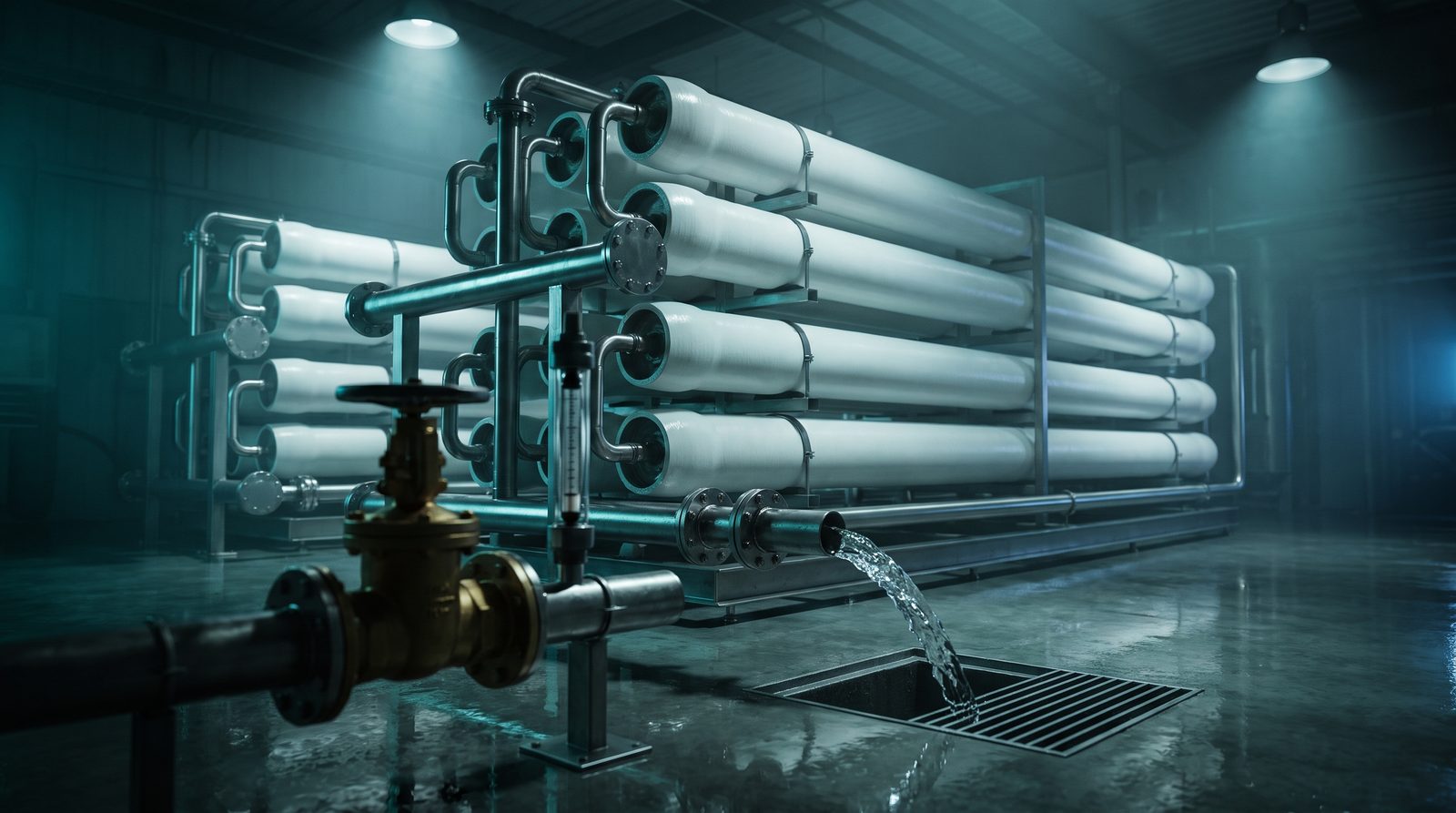
Your RO's drain flow got decided on the day somebody drew the array. The concentrate valve on the front panel has very little say in it, and that catches people out when they go looking for savings on the water bill.
Take a commercial system built on one pressure vessel with four 8040 elements, 400 square feet each, running on well water at 18 gfd. It makes 28,800 gallons a day of permeate and it pushes 18,720 gallons a day out the concentrate line. That's 61 percent recovery, and every one of those 18,720 gallons got paid for twice, once on the water side of the bill and again on the sewer side. The reflex is to close the concentrate valve a turn. Do that and you'll lose a set of membranes before you save a month of water.
The number is calculable though, and once you've run it you'll know inside ten minutes whether your system has room to improve or whether it's already against the wall.
Recovery is the number, everything else is bookkeeping
Recovery is permeate flow divided by feed flow. Concentrate is whatever's left, so recovery and reject always add to 100 percent. Any "3 to 1 waste ratio" you read is somebody restating a recovery figure in a different unit, usually without saying what feed water or what array they had in mind.
What matters on a bill is gallons of feed per 1,000 gallons of product:
| System recovery | Feed per 1,000 gal permeate | To drain per 1,000 gal permeate | Concentration factor |
|---|---|---|---|
| 50% | 2,000 gal | 1,000 gal | 2.0x |
| 61% | 1,650 gal | 650 gal | 2.5x |
| 70% | 1,429 gal | 429 gal | 3.3x |
| 75% | 1,333 gal | 333 gal | 4.0x |
| 80% | 1,250 gal | 250 gal | 5.0x |
That last column decides whether you're allowed to move up the table. Concentration factor is 1 divided by (1 minus recovery), and it tells you how many times over the rejected salts pile up in the concentrate stream. Going from 61 percent to 80 percent recovery cuts your drain flow by more than half and doubles the scaling load on the tail element at the same time.
The tail element puts a hard floor under the drain flow
Every 8040 element needs a minimum flow leaving it, and manufacturers publish that number as a hard design limit. The concentrate stream is what sweeps rejected salts off the membrane surface, so it has a job to do besides leaving. Drop below it and the boundary layer at the membrane face concentrates far past what your feed analysis predicts.
DuPont publishes these limits for 8-inch FilmTec elements by feed source. For a 400 or 440 square foot brackish element on well water at SDI under 3, minimum concentrate flow is 13 gpm and maximum element recovery is 19 percent. On conventionally pretreated surface water at SDI under 5 it tightens to 15 gpm and 15 percent. On conventionally treated wastewater it's 16 gpm and 13 percent. The design flux range for that well water case is 16 to 20 gfd, and maximum feed flow into a 400 square foot element is 75 gpm.
Now put those numbers back into the single-vessel system from the top. Four elements at 18 gfd give you 20 gpm of permeate. The tail element still needs 13 gpm going past it. Feed has to be 33 gpm, so recovery lands at 60.6 percent and there is no valve position, no pump, and no membrane brand that changes it. One vessel of four elements can't run high recovery, because a fixed 13 gpm floor is an enormous fraction of a 33 gpm feed.
Add a second stage and the arithmetic opens up. A 2 to 1 array, two vessels feeding one, six elements each, makes 80 gpm of permeate at 16 gfd. The same 13 gpm tail floor now caps you at 86 percent recovery instead of 61 percent, because there's four times as much permeate stacked against the same floor. Staging is the whole trick: the tail vessel keeps its crossflow while the front of the array does the volume.
Feed chemistry sets the ceiling above that floor
Hydraulics tell you the most recovery your array can physically reach. Your water tells you how much of that you're allowed to use.
At 75 percent recovery everything rejected is four times more concentrated in the reject than in the feed. A feed carrying 25 mg/L of reactive silica arrives at the tail at 100 mg/L. Push to 80 percent and it's 125 mg/L. Amorphous silica goes into solution to about 120 mg/L at 25 degrees C and neutral pH, so a fairly ordinary South Texas well can hit the silica wall somewhere in the high seventies, and silica scale doesn't clean off with the acid and caustic in your CIP cart.
Hydranautics publishes the saturation limits its design software alarms on, calculated in the concentrate stream where 100 percent means normal solubility with no antiscalant. Calcium carbonate alarms at an LSI of positive 1.8, with suppliers reporting efficacy as high as positive 2.9. Calcium sulfate alarms at 230 percent of saturation, strontium sulfate at 800 percent, barium sulfate at 6,000 percent, silica at 100 percent. Without an antiscalant the recommended target is an LSI of negative 0.2 in the concentrate, which is a far lower recovery on most municipal or well feeds. That gap between negative 0.2 and positive 1.8 is what a correctly dosed antiscalant program buys you, and it's usually worth more recovery points than any other single change.
What moves the number, in the order worth trying
Start with the antiscalant, because it's cheap and it raises the chemistry ceiling immediately. Get a current full feed analysis to your chemical supplier, including barium and strontium at 10 ppb detection and reactive silica, and let their program set the dose and the maximum recovery. Then acid feed, if carbonate rather than sulfate or silica is what's binding you.
After that comes array work, and that's a real project. Adding a second stage means new vessels, new piping, a bigger feed pump, and a shutdown long enough to install all of it, since a 2 to 1 array raises the pressure the front end has to develop. Concentrate recirculation is the cheaper cousin: pipe part of the reject back to the pump suction so the vessel keeps its crossflow while less water leaves the system. You pay for it in feed TDS, which rises across the whole array and pushes permeate conductivity up with it, plus the pumping energy to pressurize the same water twice.
Reuse is the option people skip. RO reject from a low TDS municipal feed at 61 percent recovery is 2.5 times the feed TDS, which is often still cleaner than the raw water some plants use for cooling tower makeup, wash-down, irrigation, or toilet flushing. Chlorides, conductivity, hardness, and silica all have to clear the receiving system's limits, and the antiscalant carries over into the reject, so check compatibility with your tower program before you plumb it. Ask your discharge permit too, because sending less volume at higher TDS can move you into a surcharge bracket.
The failure that looks like water savings
Someone closes the concentrate throttle to bring the drain flow down. The flow meter reads lower, recovery reads higher, and the first week looks like a win.
Inside the tail element, crossflow velocity dropped and element recovery jumped past the design limit. Concentration polarization at the membrane face climbs, salts precipitate where the sweep is weakest, and scale starts building on the last elements in the last vessel. You'll see it as differential pressure creeping up on the second stage while permeate conductivity drifts up too, and normalized permeate flow falls off. By the time it's obvious the deposit has usually been there for weeks. Pull the tail element and it weighs noticeably more than the lead one, with a gritty white film on the feed spacer.
The tell arrives before the damage does, if somebody's logging. Element pressure drop is capped at 15 psi per element and 50 psi per vessel on both DuPont and NanoH2O brackish elements. A stage ΔP climbing 10 to 15 percent over its clean baseline is your warning, and it shows up long before rejection moves.
Where to spend the money
Run the tail-flow arithmetic first. If your array is one vessel, your recovery is capped near 60 percent by hydraulics and no amount of chemistry or valve work will change that, so the question becomes whether a second stage pencils out. On a 28,800 gpd system in McAllen, where commercial water runs $3.15 per 1,000 gallons, moving from 61 to 75 percent recovery saves 317 gallons of feed per 1,000 gallons of product, about $10,000 a year on the water side alone before you count sewer. If your array already has stages, your ceiling is chemical and the money goes into the antiscalant program and a current feed analysis instead.
The array sets your recovery, and the element you load into it sets how much headroom you keep once you're running near the limits. NanoH2O (formerly LG Chem / LG NanoH2O) rates the BW 400 R G2 at 85 gpm maximum feed flow against 75 gpm for the FilmTec BW30 PRO-400, on a 34 mil low differential pressure feed spacer versus 28 mil, at 11,500 gpd and 99.8 percent stabilized rejection versus 11,000 gpd and 99.6 percent. More crossflow allowed at the front, and less pressure drop burned per element. Both of those are what a high recovery array runs out of first. FilmTec is the default in most plants because it's been the default for thirty years and every contractor knows the part number, and that's an argument about habit rather than about specifications.
Enviro Membranes stocks NanoH2O 8040 elements including the BW 400 R G2, BW 440 R G2, and SW 400 R, with same-day US shipping and wholesale pricing. Send us your feed analysis and current array layout and we'll tell you where your recovery ceiling really is before you buy anything. enviromembranes.com
Sources
- Membrane System Design Guidelines for 8 inch FilmTec Elements (Form 45-D01695-en), DuPont Water Solutions
- FilmTec BW30 PRO-400 Element Product Data Sheet (Form 45-D03742-en), DuPont Water Solutions
- LG BW 400 R G2 Brackish Water RO Element Product Data Sheet, NanoH2O
- Chemical Pretreatment for RO and NF, Technical Application Bulletin 111, Hydranautics
- Silica removal to prevent silica scaling in reverse osmosis membranes, Desalination
- Chapter 106 Utilities, Standard water rate schedule within the city, City of McAllen Code of Ordinances
- Brackish Water Reverse Osmosis: Why Feed Chemistry Sets Your Recovery Limit, Enviro Membranes
- Reverse Osmosis Antiscalant: How the Dose Gets Set, and How the Program Fails, Enviro Membranes