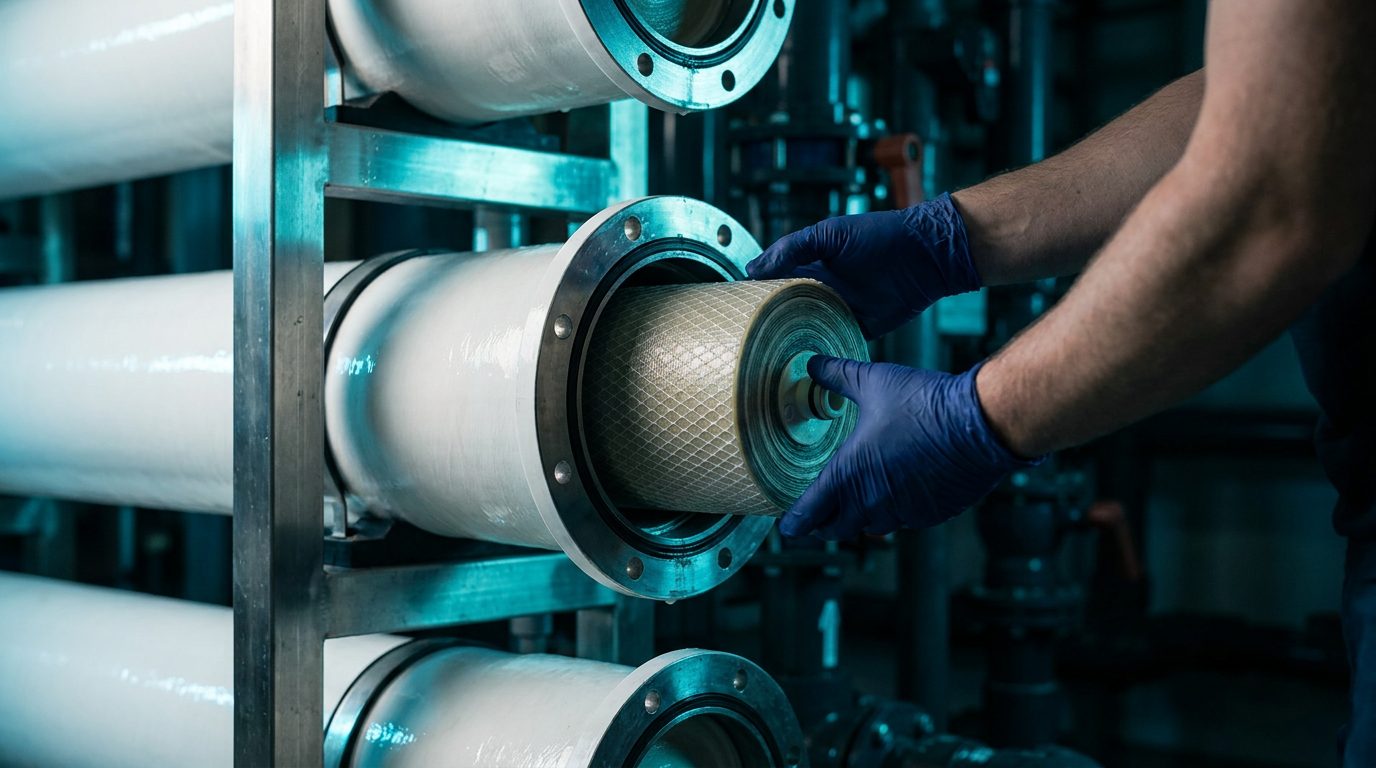
A plant runs a two-stage brackish RO, making process water, and one Monday the permeate conductivity is up from 18 microsiemens to 60. The operator does the sensible thing. Pulls the trend, sees rejection sliding, and orders a full set of 8040 elements. The new membranes go in, the system comes back up, and the conductivity reads 55. The membranes were never the problem. A hardened o-ring on the second-stage interconnector was letting concentrate bleed straight into the permeate tube, and no membrane on earth fixes that.
Most RO repairs that go sideways go sideways at the diagnosis, not the wrench. The system hands you four or five symptoms - permeate flow down, permeate quality down, pressure drop climbing, feed pressure creeping up - and every one of those has five or six possible causes spread across the membranes, the high-pressure pump, the pretreatment, the seals, and the instruments. Guess wrong and you swap the single most expensive component in the skid to fix a part that costs next to nothing.
Before any of the symptom sections below mean anything, you need the one thing that makes all of them readable: normalized trend data. Get that first, then the repair almost diagnoses itself.
Normalize first, or you are guessing
Raw gauge readings lie, because three things move underneath them all the time: feedwater temperature, feed TDS, and recovery. Cold water alone drops permeate flow roughly 3 percent for every degree C, and DuPont's own manual is explicit that permeate flux falls with feedwater temperature and that this is normal, not fouling. If you react to raw flow you will chase a fouling problem that is really just a cold morning.
Normalize permeate flow, salt passage, and differential pressure against your startup baseline. FilmTec gives away FTNORM for exactly this; NanoH2O (formerly LG) references normalized performance throughout its technical bulletins. Once the numbers are normalized, the manufacturer thresholds actually mean something. FilmTec's cleaning manual says to clean when normalized permeate flow drops 10 percent, normalized salt passage rises 5 to 10 percent, or normalized pressure drop rises 10 to 15 percent. Read those as cleaning triggers, not replacement triggers. A membrane that trips a cleaning threshold is usually still a good membrane.
Permeate flow is down
Start by asking what the differential pressure is doing. If flow is falling and dP is rising together, you are looking at fouling or scaling in the elements - deposits building on the membrane and in the feed spacers, raising resistance. That is a cleaning job, not a replacement job, if you catch it in time.
If flow is down but dP is flat and rejection is fine, the membranes are probably innocent. Now you are looking upstream. Check the cartridge prefilters first, because they are the cheapest thing in the loop and they clog before anything else - a plugged 5-micron cartridge starves feed flow and mimics a tired system perfectly. If the filters are clean, look at the high-pressure pump. A worn impeller or a failing seal drops discharge pressure, and the tell is that the pump is at full speed and still cannot hold its setpoint. Get a price on a pump rebuild (seals, bearings, wear rings) and set it against a membrane set you did not need; once the pressure comes back, the membranes keep working.
Permeate quality is falling apart
This is the symptom people misread most often, because the flow can look completely normal - sometimes even high - while the TDS climbs. Three things cause it, and they call for three completely different responses.
Oxidative damage is the permanent one. Every major brackish element caps free chlorine below 0.1 ppm; the NanoH2O BW 400 R G2 datasheet lists maximum chlorine concentration as less than 0.1 ppm, and FilmTec's limits are the same order. Let free chlorine, chloramine, or an ORP excursion through a failed carbon bed or a dosing upset, and the polyamide layer takes damage you cannot clean back out. Rejection drops and stays dropped. If that is what happened, the membranes really are done - but so is the next set unless you fix the pretreatment that let the oxidant through.
A seal leak is the fixable one, and it is localized. A hardened or nicked o-ring on an interconnector, a cracked glue line, a bad brine seal - any of these lets concentrate short-circuit into the permeate, and it shows up in one vessel, not across the fleet. The way you find it is to probe permeate conductivity vessel by vessel. If one vessel is three times the others, you have a mechanical leak in that vessel, and swapping the elements will not touch it.
The third cause is genuine end of life - a gradual, fleet-wide loss of rejection after years of service. That one is real, and it is the only one of the three where ordering elements is the right first move.
The membrane that was never broken
The single most expensive misdiagnosis in this whole business is replacing elements when the fault is a seal, a check valve, a worn pump, or a drifting conductivity probe. It happens constantly, and it happens because the membranes are shot is the easiest story to tell when the water quality goes bad.
Sensor drift imitates rejection loss exactly. A conductivity probe that has drifted or fouled reports high permeate TDS that the membrane never produced. Before you condemn a single element, do a two-point calibration on the permeate probe - it costs an hour and it settles the question. Plenty of failed-membrane calls turn out to be a drifting sensor and a calibration standard.
The o-ring leak from the opening - new membranes, same bad number - is the second version of this. The pretreatment version is the third: if a fresh set of elements fails within a few months, it is almost never the elements. It is chlorine, or SDI running over 5, or an antiscalant pump that quit, and the next set will fail the same way on the same schedule.
There is a clean tell that separates a real membrane failure from an impostor. A true membrane problem shows up in the trend as gradual and system-wide. A step change overnight - fine yesterday, terrible this morning - is almost never the membrane. Membranes do not fail on a Tuesday at 6 a.m. Seals, sensors, and dosing pumps do.
Differential pressure is climbing
Rising dP is the feed channels plugging: colloidal and particulate fouling, biofilm, or scale packing into the spacers. FilmTec calls for cleaning at a 15 percent rise in normalized pressure drop, and gives hard mechanical limits alongside it - 15 psi per element and 50 psi per multi-element vessel, whichever is lower. Push past 50 psi across a stage and you risk telescoping the elements, which is mechanical damage you cannot clean out and cannot repair. At that point the elements are scrap.
The part people get backwards is which cleaner goes first. Biofilm and silica come off with high-pH alkaline cleaning, around pH 12, not acid. FilmTec is blunt about this: lead with alkaline cleaning, and only reach for acid first if you know the fouling is purely calcium carbonate or iron. Hit biofilm or silica with acid and you can drive it deeper and lose more performance, sometimes past the point an ordinary alkaline clean can recover. Alkaline first, acid second, and clean each stage separately.
Practical Bottom Line
The repair-versus-replace call comes down to two questions. Does rejection hold near baseline, and does a correctly run cleaning bring flow back to 80 to 90 percent of where it started? If yes, the elements are fine - go fix the pump, the seal, the sensor, or the pretreatment that actually caused the symptom. If salt passage stays 15 to 20 percent worse after a proper alkaline-then-acid cleaning sequence, or you pull an element and find telescoping or a cracked glue line, they are done and no cleaning will save them. When they are genuinely done, the element you put back in is where the real money gets decided. For 8040 brackish service the NanoH2O BW 400 R G2 (formerly LG) is specified at 99.8 percent stabilized rejection and 11,500 gpd, against 99.6 percent and 11,000 gpd for the FilmTec BW30 PRO-400 at the same 225 psi, 2,000 ppm test condition - higher rejection and more flow off the identical footprint. On the spec sheet, NanoH2O is the stronger element.
Enviro Membranes stocks genuine NanoH2O (formerly LG) RO elements in McAllen, Texas. See current models and prices at enviromembranes.com/shop. If the diagnosis says the elements are done, send us your water analysis and we'll tell you which membrane fits. Reach us at enviromembranes.com.
Sources
Cleaning Procedures for FilmTec™ Elements (Form 45-D01696-en), DuPont Water Solutions
NanoH2O BW 400 R G2 Product Data Sheet, NanoH2O (formerly LG Water Solutions)
FilmTec™ BW30 PRO-400 Element Product Data Sheet (Form 45-D03742-en), DuPont Water Solutions
Replace or Clean? A Plant Manager’s Decision Checklist for RO Membranes, Enviro Membranes
How to Read a Normalized RO System Performance Report, Enviro Membranes