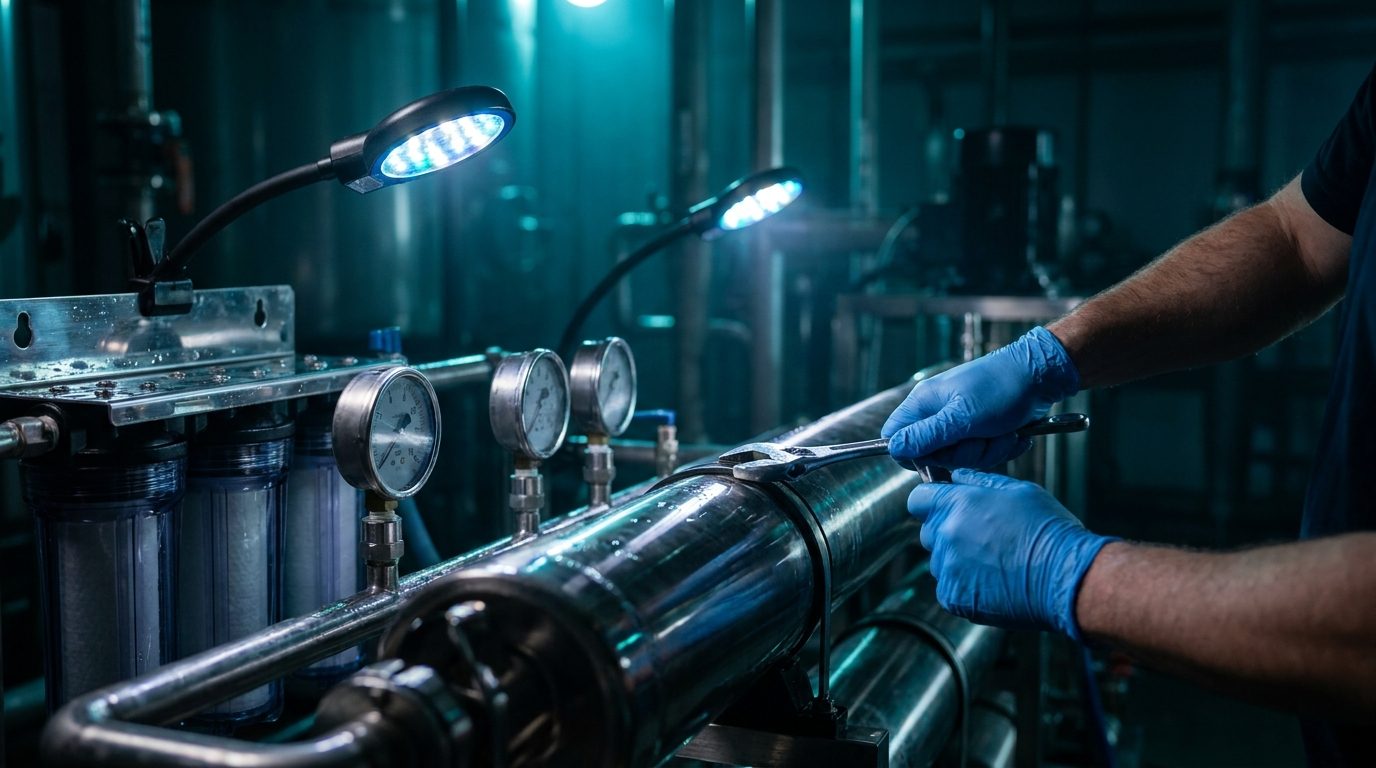
A food plant outside Laredo called last spring because their RO system had “stopped making water.” It hadn’t stopped. It was making noticeably less than it did the year before, and the operator only noticed when a downstream tank quit keeping up with demand. He’d been changing cartridge filters on the calendar like clockwork and writing the date on the housing with a marker. What he hadn’t been doing was normalizing the permeate flow. So the system had been sliding a little at a time and every gauge on the skid still read inside its normal band because feed pressure had crept up to compensate. By the time it was obvious, the first-stage elements were scaled hard enough that no cleaning was going to bring them back.
That’s the gap that sinks most commercial RO maintenance programs. The calendar tasks get done. Cartridges get swapped, the antiscalant drum gets topped off, somebody hoses down the skid. And the system still fails, because none of those tasks tell you what the membrane is actually doing. Maintenance on an RO system isn’t a checklist you run against the clock. It’s a running comparison between what the system produced when it was new and what it’s producing today, corrected for temperature and pressure. Everything else is housekeeping.
None of this is exotic. The intervals and thresholds below come off manufacturer technical manuals, and the failures behind them repeat from plant to plant. The trick is knowing which number to trust, and when a small change means clean now versus a small change means you already waited too long.
What actually needs doing, and how often
The tasks that keep a commercial RO system alive fall into a handful of intervals.
Cartridge prefilters, the 5-micron sediment cartridges ahead of the high-pressure pump, get inspected weekly and changed on differential pressure, not on a date. The number that matters is the ΔP across the cartridge housing. When it reaches the change-out ΔP your cartridge maker lists, change them. If you’re only getting two weeks out of a set, the problem is upstream and no cartridge schedule will fix it.
Antiscalant dosing gets checked every shift, or at least daily. This is the single fastest way to wreck a first stage. A dosing pump that’s lost prime, a drum that ran dry over the weekend, a stroke setting someone bumped; any of those puts you into scaling territory within hours at high recovery. Verify the pump is stroking, verify drum level, and recalculate the dose any time feed flow or recovery changes.
CIP (clean-in-place) doesn’t run on a calendar at all. You clean when the normalized numbers say to. How often does yours clean? If you’re cleaning monthly, something in pretreatment is broken and the CIP is just papering over it.
Instrument calibration (flow meters, pressure transmitters, conductivity cells, pH and ORP probes) runs monthly to quarterly, verified against grab samples. This one gets skipped because the instruments “look fine,” and it’s exactly the skipped calibration that hides a developing problem. A conductivity cell drifting low will happily tell you rejection is fine while salt passage climbs.
Membrane replacement is not an interval. Elements in clean brackish service with decent pretreatment last years longer than elements on a bad feed with a skipped antiscalant check. You replace when normalized flow won’t recover after a proper clean and normalized rejection has fallen past what your process can tolerate, not because the calendar says three years.
The numbers that tell you the truth
Gauges lie. Not literally, but a feed-pressure gauge reading 200 psi tells you nothing on its own, because the same 200 psi means one thing at 60°F and another at 78°F, and another again at 20% recovery versus 15%. What you actually track is the normalized set: permeate flow, salt passage, and differential pressure, all corrected back to a fixed reference so you’re comparing today’s membrane against the day it was commissioned.
DuPont’s FilmTec technical manual puts hard triggers on those numbers, and they’re a good standard no matter whose membrane you run. Clean when normalized permeate flow drops 10%, when normalized salt passage rises 5 to 10%, or when the pressure differential across a stage climbs 15%. Those three are early warnings, not failure points. Hit any one of them and you clean, while a clean still works.
Differential pressure has a second, harder limit. FilmTec caps pressure drop at 15 psi per element and 50 psi per multi-element vessel, whichever comes first. Those aren’t cleaning triggers (by the time you’re near them you’re well past the 15% rule); they’re the ceiling past which you start telescoping elements and doing mechanical damage. If you’re watching stage ΔP climb toward those numbers, you already missed the window.
Feed water quality has its own gate: SDI15 at or below 5, turbidity under 1.0 NTU. Those are hard limits on every major brackish membrane, NanoH2O (formerly LG) and FilmTec alike. An SDI creeping from 3 to 4.5 is your pretreatment telling you it’s losing ground, and it shows up as rising cartridge ΔP before it ever touches the membranes. Log the feed SDI, especially after any pretreatment change or raw-water upset.
Write all of it down every shift: normalized flow, salt passage, feed and interstage pressure, stage ΔP, conductivity at feed, permeate, and concentrate, temperature, recovery, and antiscalant dose. One page. The value isn’t any single reading. It’s the slope. A membrane almost never fails on a Tuesday. It slides for weeks, and the log is the only thing that makes the slide visible before it’s a scaled first stage.
Chlorine is the failure that doesn’t wait
Most RO failures are slow. Chlorine isn’t. Thin-film composite polyamide membranes, which is nearly everything in commercial brackish service, have a free chlorine tolerance below 0.1 ppm, and once oxidation starts it doesn’t reverse. FilmTec and NanoH2O (formerly LG) both spec the same ceiling: under 0.1 ppm free chlorine at the membrane, full stop. Push chlorinated feed through unprotected elements and you can lose rejection across a whole train in a single shift. No cleaning brings it back. Those elements are scrap.
The maintenance that prevents it lives in pretreatment: carbon beds or sodium bisulfite injection to strip residual chlorine, and an ORP probe on the RO feed as the backstop. The ORP probe is the one that actually saves membranes, because it catches a carbon bed that’s exhausted or an SBS pump that quit before the chlorine reaches the elements. Calibrate it, alarm it, and tie it to a feed shutoff if the system allows. A carbon bed on a “we’ll change it when we get to it” schedule is a membrane replacement waiting to happen.
Cleaning the calendar instead of the curve
The most expensive maintenance mistake in commercial RO isn’t skipping cleanings. It’s cleaning at the wrong time, and both directions cost you.
Clean too early, on a fixed quarterly schedule regardless of the data, and you’re running cleaning chemicals across a membrane that didn’t need them. Every high-pH and low-pH cycle takes a small bite out of the polyamide layer. Do it four times a year when the data said twice and you’ve shortened the element’s life for no operational gain.
Clean too late and you don’t get a second chance. Foulants and scale have a window where they’re still soft and soluble. Catch a calcium carbonate scale at a 10 to 15% normalized flow decline and a low-pH clean brings the membrane most of the way back. Let that same scale sit until flow is down 25 or 30% and it’s crystallized into the membrane surface. Now the low-pH clean barely touches it, and you’re pricing replacement elements. The plant near Laredo didn’t skip its cleanings. It cleaned on a calendar, and the scaling event happened between scheduled cleanings. By the scheduled clean, the first stage was gone.
The fix is boring and it works: normalize daily, clean on the 10 to 15% trigger, and treat any cleaning that doesn’t restore normalized flow as a diagnosis, not a failure. If a proper two-stage clean gets you back within a few percent of baseline, the membrane’s fine. If it doesn’t, you’ve learned something: the fouling is irreversible, and it’s time to plan a re-membrane rather than run another cleaning cycle that won’t hold.
Practical Bottom Line
Good RO maintenance is a data habit, not a task list. Normalize permeate flow, salt passage, and stage differential every shift; clean on the 10 to 15% triggers rather than the calendar; guard the membranes from chlorine with an ORP backstop; and let normalized trends, not element age, decide when to re-membrane. Do that and a brackish system gets the full life out of every set of elements.
When it’s time to buy elements, new build or re-membrane, the membrane you choose changes how much maintenance the system demands. NanoH2O’s BW 400 R G2 (the former LG line) carries a 34-mil low-pressure-drop feed spacer and rates 11,500 GPD at 99.8% stabilized salt rejection, against 11,000 GPD and 99.6% for the FilmTec BW30 PRO-400 it competes with, in the same 8040 footprint. On the published sheets the G2 shows higher flow and rejection. If you’re specifying elements for a system you have to keep clean, put the feed spacer on your comparison list next to flow and rejection.
Enviro Membranes stocks genuine NanoH2O (formerly LG) RO elements in McAllen, Texas. See current models and prices at enviromembranes.com/shop. Planning a re-membrane? Send us your water analysis and we’ll tell you which membrane fits.
Sources
- Cleaning Procedures for FilmTec Elements (cleaning triggers: 10% flow, 5 to 10% salt passage, 15% dP): DuPont Water Solutions
- Usage Guidelines for 8-inch FilmTec Elements (max dP 15 psi/element, 50 psi/vessel): DuPont Water Solutions
- FilmTec BW30 PRO-400 Element Product Data Sheet (99.6% rejection, 11,000 GPD): DuPont Water Solutions
- NanoH2O BW 400 R G2 Product Data Sheet (99.8% rejection, 34-mil low-dP spacer, SDI15 ≤ 5, <0.1 ppm chlorine): NanoH2O (formerly LG Water Solutions)
- Membrane System Design Guidelines for 8-inch FilmTec Elements: DuPont Water Solutions
- How to Read a Normalized RO System Performance Report: Enviro Membranes
- How to Clean a Commercial RO Membrane: Enviro Membranes
- Replace or Clean? A Plant Manager's Decision Checklist for RO Membranes: Enviro Membranes