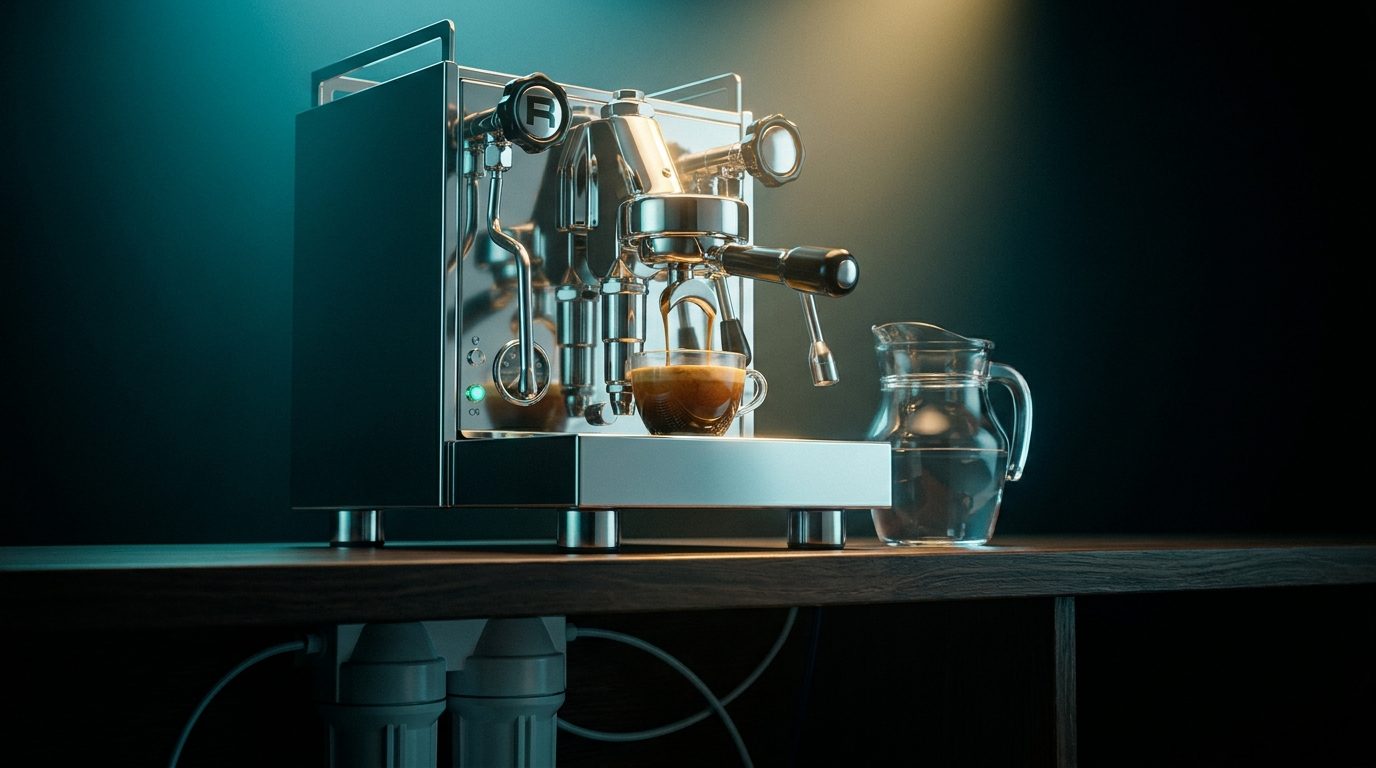
Hard water is the slow, invisible enemy of espresso equipment. Here's what it's doing to your machine, and how to stop it without sacrificing your coffee quality
Ask most café owners what causes their biggest equipment headaches and they'll say it's the espresso machine. What they usually mean is: the boiler scale, the unpredictable extraction, the repair bills that always arrive at the wrong time. What they rarely say (because they haven't been told) is that all of those problems have the same root cause: the water.
Water quality is the single most controllable variable in a coffee program. It determines scale accumulation in your boiler and group heads, affects extraction consistency, and dictates how often your equipment needs professional descaling. A reverse osmosis system, sized and configured correctly for coffee applications, addresses all of it.
What Hard Water Is Doing to Your Espresso Machine Right Now
Espresso machines operate at 195 to 205°F under 9 bars of pressure. Calcium and magnesium, the minerals that make water hard, become less soluble as temperature rises. Inside your boiler, they fall out of solution and deposit as calcium carbonate scale on every heated surface they touch.
Scale accumulates slowly. A quarter inch on a boiler heating element can cut thermal efficiency significantly and puts more strain on the heating element, shortening its service life. At 0.5 inches, the boiler may struggle to maintain target temperature during a busy service. Inside the group head, scale deposits affect flow rate and pressure consistency across multiple portafilters, the kind of variation that shows up as inconsistent shot quality you can't explain from grind adjustments alone.
In South Texas, where municipal water hardness regularly runs 15 GPG or higher, the accumulation rate is faster than in most of the country. On hard water like the supply in McAllen or Harlingen, a machine needs descaling more often. Ask your service tech how often yours does.
Professional descaling is not cheap. It's also time that takes your machine offline. And repeated chemical descaling shortens component life over time: you're removing the scale, but also etching the brass and copper internally. Prevention is worth more than the cleaning budget.
Why Pure RO Water Isn't the Answer Either
The logical solution seems obvious: remove all the minerals with an RO system and the scale problem goes away. That's correct. But it introduces a different problem: completely deionized or very low-TDS water makes poor espresso.
Specialty Coffee Association (SCA) water standards recommend a target TDS of 150 mg/L (acceptable range 75 to 250 mg/L) and a target hardness of around 50 to 175 mg/L. Completely stripped RO water (typical product TDS of 5 to 30 mg/L) is below this range. It's also slightly acidic (pH 5.5 to 6.5) due to dissolved CO₂, and it lacks the mineral content that facilitates optimal coffee extraction.
Espresso extraction is a chemical process. The compounds that produce sweetness, body, and complexity in the cup bond to specific minerals during extraction: magnesium, in particular, has been shown to enhance extraction yield in coffee research. Brew water that's too pure produces flat, sour, or hollow espresso regardless of grind, dose, or technique. Your barista can't dial out a water problem.
The correct approach is not maximum mineral removal, but controlled mineral content: remove the scale-forming compounds (primarily calcium carbonate) and replace with a controlled, coffee-optimized mineral profile.
The Right Setup for a Coffee Operation
A commercial RO system configured for espresso applications has three components that work in sequence:
1. Pre-filtration. A sediment pre-filter (typically 5 micron) and a carbon block filter before the RO membrane. The carbon removes chlorine and chloramines, which are harmful to the polyamide membrane and also affect coffee flavor. In South Texas, where municipal water regularly carries free chlorine at the disinfection dosage, this stage is not optional.
2. RO membrane. This is where the heavy mineral reduction happens. A quality commercial membrane in the 4040 format (4-inch diameter, 40-inch length) handles the volume requirements of most café operations. For high-volume shops or those with multiple brewing stations and an ice program, multiple elements or a larger system may be needed.
3. Remineralization. This is the stage that most under-counter filters skip, and where most coffee-specific RO systems distinguish themselves. A remineralization cartridge, typically containing calcium and magnesium compounds in specific ratios, adds back minerals at controlled concentrations. Target: 50 to 100 mg/L hardness and 100 to 150 mg/L TDS in the product water. This stays well within SCA guidelines and provides the mineral content that supports good extraction without scale risk.
| Water Type | Typical TDS | Effect on Espresso / Equipment |
|---|---|---|
| Untreated South TX municipal | 300 to 600 mg/L | Scale formation; inconsistent extraction |
| Straight RO (no remineralization) | 5 to 30 mg/L | Flat, sour shots; technically scale-free |
| RO + remineralization (target) | 100 to 150 mg/L | SCA-compliant; no scale; optimal extraction |
Sizing Your System: How Much Capacity Do You Actually Need?
Commercial RO systems are rated in gallons per day (GPD). "Per day" means over a 24-hour operating cycle, which is rarely how a café actually runs. Most shops are using water during 8 to 12 active hours, with some storage tank capacity to buffer demand.
For a single-group espresso machine running full service hours, pulling 150 to 200 shots per day, plus drip coffee and bar needs, total water consumption typically runs 40 to 80 gallons per day. If you're also serving ice, that adds 15 to 20 gallons daily depending on ice machine capacity.
A 100-GPD system with a 10 to 20 gallon storage tank is a reasonable starting point for most single-location coffee operations. Shops with two or more espresso machines, large ice programs, or high-volume batch brew should look at 200-GPD systems or multi-membrane configurations. Oversizing slightly is cheap; running out of treated water during service is not.
One note specific to South Texas: RO membrane production rates are rated at 77°F. At higher feed water temperatures, which can occur in summer, production rates increase slightly. At colder temperatures, they decrease. Neither effect is dramatic at typical municipal water temperatures, but it's worth knowing if your feed water is unusually warm or cold seasonally.
The Math on Prevention vs. Repair
The most common objection to installing a commercial RO system is cost. Your own numbers make the case.
Get a quote for the RO system installed with remineralization, and ask what the replacement membrane and pre-filters cost and how often your feed water will need them.
Then pull your service invoices: what did your last boiler repair cost, what would a replacement boiler or machine cost, and how many descaling visits did you pay for last year? Descaling slows the underlying problem but doesn't stop it.
Put the two columns side by side over five years. On hard water, one avoided boiler repair and fewer descaling visits go a long way toward the system's cost, and the coffee tastes better in the meantime.
What to Look For When Buying
Not all RO systems sold for coffee applications are equal. A few things to verify before purchasing:
Membrane model matters. Look for a standard 4040 or 2521 commercial membrane from a recognized manufacturer (DuPont FilmTec, Hydranautics, Toray). Proprietary filter cartridges lock you into one supplier's pricing. Standard membrane sizes mean you can source replacements competitively.
Remineralization stage should be adjustable. The best systems allow you to blend RO water with remineralized water in adjustable ratios, so you can dial in the final TDS to match your target profile. Fixed-ratio systems don't give you this control.
Check the GPD rating against your actual usage. A system rated for residential use (50 GPD) will struggle to keep up with commercial espresso demand. Commercial-rated systems (100 to 300 GPD) are the right category.
Don't skip the pre-filter for chlorine. Carbon pre-filtration before the RO membrane is essential in South Texas municipal water. It protects the membrane and improves taste.
Where Enviro Membranes Fits
Enviro Membranes stocks genuine NanoH2O (formerly LG) RO elements in McAllen, Texas. See current models and prices at enviromembranes.com/shop. Sizing a system or replacing membranes? Send us your water analysis and we'll tell you which membrane fits, even when that's a size we don't carry.
We're based in the Rio Grande Valley and understand what South Texas water does to equipment. Reach us at enviromembranes.com or call our McAllen office.
Sources: Specialty Coffee Association Water Quality Handbook; TCEQ Surface Water Quality Data; U.S. Geological Survey water hardness data; DuPont FilmTec commercial membrane product data sheets.